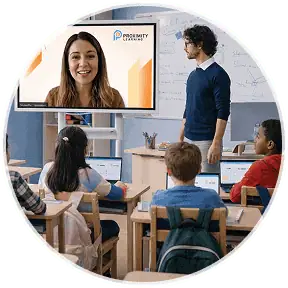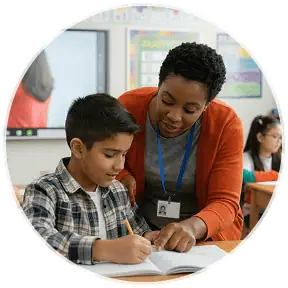


Science is meant to be explored, tested and questioned. So what happens if a certified teacher isn’t physically in the room? Can students still get lab experience? With effective virtual science instruction, they can. Live teachers combine hands-on experiments, virtual labs, simulations and real-time discussions to keep students actively participating in science. For district leaders facing vacancies, expanding access to qualified science teachers doesn’t have to mean giving up hands-on lab experiences. The teacher may be remote, but the curiosity, discovery and student learning still happen right in the classroom.
What Is Virtual Science Instruction?
Virtual science instruction connects students with a certified science teacher who teaches remotely through live, interactive technology. Students still learn together in their physical classroom, with an in-person facilitator supporting classroom needs. Effective virtual science combines direct teaching with experimentation, collaboration and inquiry. It isn’t about moving a textbook onto a screen. It’s about giving students meaningful ways to investigate how the world works.
How Synchronous Virtual Science Instruction Works
During a synchronous science class, the teacher livestreams into the classroom and interacts with students in real time. The teacher can demonstrate concepts, ask questions, lead discussion and guide science experiments while the facilitator supports activities in the room. Depending on the course and learning objective, science instruction can incorporate:
- Everyday materials
- Hands on activities
- Virtual science labs
- Interactive simulations
- Digital tools
- Game-based warm-ups and assessments
- Small-group collaboration
Students still make observations, collect data, create graphs and analyze evidence as an experiment unfolds. The teacher can question their conclusions and ask them to explain their reasoning. This keeps the scientific process at the center of the experience, even when the teacher isn’t physically in the room.
Benefits of Virtual Science Instruction for Districts and Students
Virtual instruction can expand access to strong science education while giving schools more ways to deliver experiments safely and consistently. And the benefits are numerous:
- Access to certified science teachers: Districts can easily access qualified educators beyond commuting distance when local science positions are difficult to fill.
- More science course options: Schools can expand access to biology, chemistry, physics and high school biology when qualified teachers aren’t available locally.
- Safer experimentation: Virtual labs can simulate hazardous activities and chemical reactions without exposing students to unnecessary physical risks.
- More opportunities to experiment: Digital labs allow students to repeat experiments, adjust variables and investigate how different choices affect results.
- Consistent lab experiences: Virtual environments give students access to the same materials, procedures and conditions for an experiment.
- Better visualization: Simulations demonstrate microscopic, abstract, or complex concepts that might be difficult to observe during a physical experiment.
- Lower material demands: Virtual experiments reduce the physical equipment and consumable resources needed for classroom labs.
- Flexible reinforcement: Students can revisit certain labs and simulations to strengthen their understanding of challenging concepts.
5 Ways Virtual Teachers Make Science Hands-On
Hands-on science isn’t defined by whether the teacher is standing beside the lab table. It happens when students investigate questions, test ideas, make observations and use evidence to reach conclusions. Strong virtual teaching keeps students active in that process rather than asking them to simply watch.
1. Turn Everyday Materials Into Real Experiments
Not every experiment requires a fully stocked lab. Science teachers can design safe, hands-on experiments around everyday materials that are affordable and accessible for the classroom. The facilitator can distribute materials while the virtual teacher guides each step live. For example, middle school students might explore density with water and common objects. Older students might investigate forces using simple classroom materials. Choosing activities around the learning goal keeps experimentation meaningful rather than doing an activity simply because it looks like fun.
2. Use Virtual Labs When Physical Experiments Aren’t Practical
Some experiments require costly equipment, hazardous substances, or conditions a typical classroom can’t reproduce. Virtual labs remove many of those barriers by allowing students to investigate the same scientific ideas digitally. Students can change variables, repeat trials and compare results without resetting physical labs after every attempt. They can also explore processes that would be difficult or unsafe to recreate in real life. This makes virtual science labs especially useful for complex chemistry projects and other challenging experiments.
3. Make Students Predict Before They Experiment
The most valuable part of an experiment is often before anything actually happens. Teachers can ask students to predict an outcome and explain why they expect it. Then students can compare that prediction with the evidence they collect.
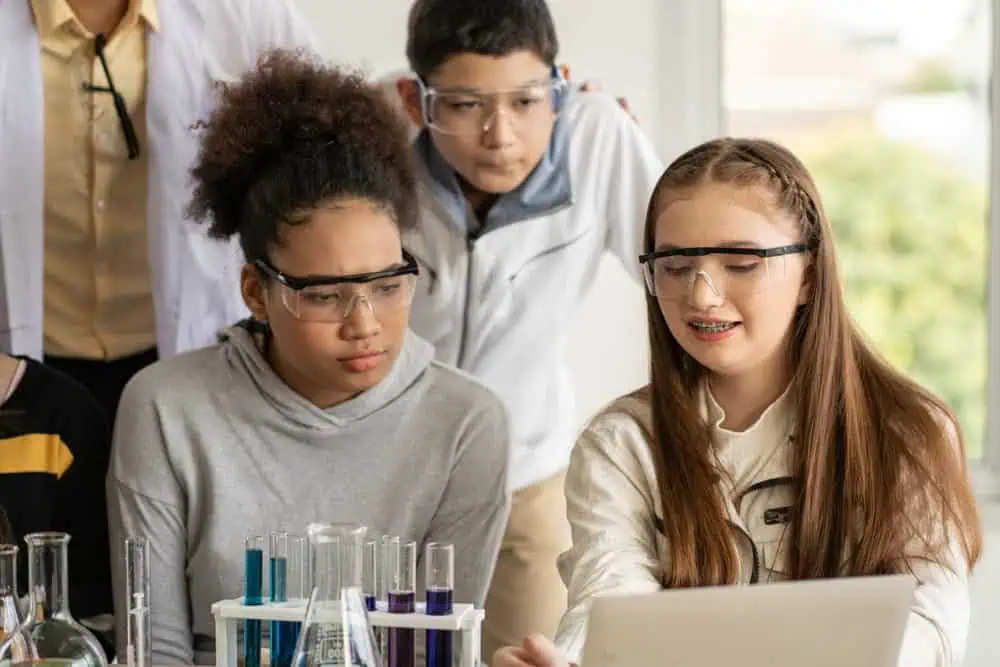
This simple step reveals student thinking and helps teachers identify misconceptions early. It also encourages the habits real scientists use when forming hypotheses and testing their ideas. Instead of waiting for the correct answer, students learn to question, investigate and revise their reasoning. This can increase their confidence and boost student results.
4. Put Observation and Data at the Center
Watching something happen isn’t the same as investigating it. Students should record what they observe, measure results, organize data and look for relationships throughout an experiment. From there, students can create graphs and analyze their findings. Teachers can ask what students notice, what changed and what evidence supports their conclusions. These questions build scientific skills while helping teachers see whether students truly understand the underlying concepts.
5. Turn Results Into Discussion
An experiment shouldn’t end when the final measurement is recorded. The results create an opportunity for students to compare findings, challenge assumptions and explain patterns together. Whole-class or small-group discussion lets students hear different explanations and defend their own conclusions with evidence. That process strengthens scientific reasoning and deeper understanding. It also helps spark curiosity by showing students that unexpected results can lead to better questions.
What Districts Need to Make Virtual Science Work
Great virtual science doesn’t happen through technology alone. Districts need the right classroom setup, clear processes and prepared people working together. Building that foundation gives teachers more freedom to focus on engaging instruction while helping students participate safely and consistently.
- Reliable technology: Provide dependable internet, student devices, cameras, audio equipment and compatible browser access so technical problems don’t interrupt instruction.
- Accessible science resources: Make required lab supplies, digital resources, simulations and other learning tools available before each activity begins.
- Trained virtual teachers: Ensure educators have training in synchronous instruction, digital engagement, inquiry-based lessons and adapting traditional activities for virtual delivery.
- Prepared in-class facilitators: Train facilitators to manage classroom logistics, distribute materials, troubleshoot basic technology and support students during experiments.
- Clear safety procedures: Establish expectations for handling materials, completing experiments, cleanup and a response when an activity doesn’t go as planned.
- Intentional instructional design: Choose physical experiments, digital labs, or simulations based on what will best help students understand the scientific concept rather than defaulting to one format.
Bring Hands-On Science Into More Classrooms With Proximity Learning
A science teacher doesn’t have to be in the room for students to investigate, experiment and ask great questions. With the right approach, virtual instruction preserves what makes science exciting while expanding access to qualified teachers. Proximity Learning brings over 15 years of synchronous instruction experience to that challenge. Certified teachers lead students live while facilitators provide support in the physical classroom. Interactive technology, hands-on activities and courses that match district curriculum help make science an active learning experience. It’s a model built around people, not screens. A science vacancy shouldn’t limit student exploration. Talk to us today to learn how Proximity Learning can connect classrooms with certified science teachers and keep discovery happening.