 Proximity Learning Team

The term “virtual learning” may bring to mind the early months of the COVID-19 pandemic: students learning from home, teachers adapting overnight, and districts doing their best with tools and circumstances they never planned for. That experience shaped how many people think about online instruction. It also left district leaders with a reasonable question: Is a live virtual teacher really different from what schools have already tried?
The answer is yes, and you can see the difference in every class period. Synchronous instruction is live, real-time teaching led by a certified teacher. Students can ask questions, respond, participate, and receive feedback while instruction is happening. The teacher isn’t sending students to a recording or leaving them to work through a course independently.
For district leaders evaluating staffing and instructional options today, that distinction matters. Here’s what truly synchronous instruction looks like, how it differs from emergency remote learning, and what to ask before choosing a provider.
Key Takeaways
- Synchronous instruction is live. A certified teacher teaches students in real time rather than relying on prerecorded lessons or self-paced coursework.
- It’s fundamentally different from pandemic-era emergency remote learning. Emergency remote learning was a rapid response to an unprecedented disruption. Purpose-built synchronous instruction is designed around live teaching, interaction, and classroom support.
- The in-classroom facilitator matters. Students stay in a supervised classroom. The in-classroom facilitator supports routines and student needs, and the certified teacher leads live, synchronous instruction.
- “Virtual learning” is used here mainly for contrast. The more precise term for this model is live, synchronous instruction.
Why the “Virtual Learning” Distinction Matters for District Leaders
District skepticism about virtual learning didn’t come out of nowhere. In early 2020, schools had to move instruction online with very little time to prepare. According to the National Center for Education Statistics, 77% of public schools reported moving some or all classes to online distance-learning formats during the early stages of the pandemic. That distance learning could be self-paced as well as real-time.
That was an emergency response, not a controlled rollout of a new instructional model. Teachers, students and families were suddenly navigating unfamiliar technology, different schedules, and new expectations. In an April 2021 survey, Pew Research Center found that 93% of parents with K-12 children said their children had received some online instruction since the pandemic began, underscoring just how widespread that experience was.
So it’s reasonable for a superintendent or principal to hear “virtual” and wonder whether students will be watching screens on their own. That misconception is exactly why it pays to look past the label. A purpose-built synchronous model starts with the teacher and the instructional experience. The teacher is live. Students are expected to participate. The classroom remains supervised. And the district can evaluate the quality of instruction, teacher credentials and student performance just as it would with any other instructional model.
What Synchronous Instruction Actually Means
Live, Real-Time Delivery by a Certified Teacher
The defining feature of synchronous instruction is simple: the teacher is there as the lesson happens.
In a synchronous class, a certified teacher delivers live instruction according to the school’s schedule. Students can hear and see the teacher, respond to questions, participate in discussions, and receive feedback without waiting for an email or assignment review.
That makes synchronous instruction fundamentally different from a library of prerecorded lessons. A recording can’t notice that half the class is confused about a concept and adjust the explanation accordingly. A live teacher can.
Two-Way Interaction, Not One-Way Video
A livestream by itself doesn’t make instruction synchronous in any meaningful sense. Students need opportunities to interact with the teacher and with one another.
That means answering questions, participating in discussion, working through problems, completing activities, or receiving immediate feedback. The teacher can also adjust the lesson based on what students are doing in the moment. That takes a teacher who is trained to lead a live room.
This is one reason teacher training matters. The National Virtual Teacher Association’s certification program focuses specifically on virtual instruction practices, including building relationships, differentiation, and managing virtual resources.
Proximity Learning similarly trains teachers for synchronous teaching, including student engagement, communication, and synchronous pedagogy.
The In-Classroom Facilitator’s Role
A synchronous model doesn’t leave students sitting alone in front of screens.
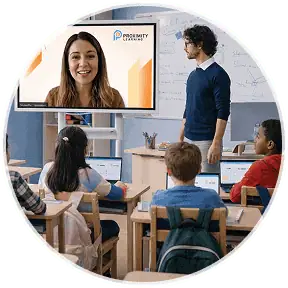
Students remain in a physical classroom with an in-classroom facilitator who provides the in-person support students need. The facilitator helps maintain classroom routines, supports participation, addresses immediate student needs, and communicates concerns to the teacher. The roles are distinct. The certified teacher leads instruction. The facilitator supports the classroom. A peer-reviewed study of Proximity Learning’s work with Memphis-Shelby County Schools describes this two-layer model directly: certified teachers delivered live instruction while in-class facilitators provided classroom support.
That distinction is important for districts evaluating providers. The question to ask is whether instructional responsibility sits with a qualified teacher while students also have appropriate in-person support. An adult in the room is only part of the answer.
How Synchronous Instruction Differs From Pandemic-Era Virtual Learning
Prerecorded Video vs. Live Instruction
Watching a lesson and participating in a lesson are different experiences. Prerecorded video can be useful as a supplement. It can explain a concept, provide review or allow students to revisit material, but it can’t respond to students in real time.
Synchronous instruction can. The teacher can ask a question, see who understands, hear a student’s reasoning and address confusion immediately. Students participate in the lesson as it happens. That’s central to Proximity Learning’s model: classes are taught live by certified teachers rather than through prerecorded lectures or asynchronous coursework.
Unsupervised Screens vs. Facilitator-Supported Classrooms
Another common memory from the pandemic is the student learning from home, often without an adult available to provide immediate support. That arrangement created challenges that had little to do with whether a teacher was good at teaching. A purpose-built, school-based synchronous model changes the setting.
Students are in a classroom and a facilitator is physically present. The certified teacher is teaching live. Students have a defined class period and school-day structure rather than being expected to manage an entire online course independently.
Chicago Public Schools’ current Virtual Academy, for example, describes its instructional model as 100% synchronous, with full-group instruction, small-group collaboration and independent practice. Programs labeled “virtual” vary widely, so district leaders should ask how much structure and adult support actually surrounds the technology.
Emergency Stopgap vs. Trained, Certified Model
Emergency remote learning had to be implemented quickly because schools had no alternative. Purpose-built synchronous instruction starts with a different goal: deliver quality instruction through a live teacher who is trained for the environment.
That means districts can evaluate the model before implementation. Who teaches the class? What credentials does that teacher hold? What training does the teacher receive? How does the school support students in the room? How is student progress monitored? Proximity Learning has provided synchronous instruction since 2009, so its model predates the pandemic by more than a decade.
This distinction matters because a district is not choosing between “in-person school” and “a screen.” It’s choosing how qualified instruction is delivered when traditional staffing doesn’t provide the right teacher at the right time.
What District Leaders Should Look For When Evaluating “Virtual” Options
Here’s the checklist we’d want in your hands before any vendor call.
Ask Whether Instruction Is Live or Prerecorded
Start with the simplest question: Will a teacher be teaching my students live during every scheduled class period? Don’t stop at a provider’s use of words such as “interactive,” “online” or “virtual.” Ask what students actually experience.
Find out whether students can ask questions and receive immediate responses. Ask whether the teacher follows the district’s bell schedule. Find out what happens when students don’t understand a concept. If the answer involves watching recordings, completing modules independently, or waiting for feedback, the model is not the same as live synchronous instruction.
Ask About Teacher Certification and Training
A live person on a screen isn’t enough. The person teaching students should have the appropriate certification for the class and the subject expertise to teach it. Ask the provider to explain how credentials are verified, which state requirements apply, and how teachers are prepared specifically for synchronous instruction.
Training should go beyond knowing how to operate technology. The National Virtual Teacher Association’s certification framework, for example, addresses virtual teaching practices, relationships, differentiation, and resource management. Proximity Learning trains its teachers in synchronous pedagogy, student engagement, and communication, and supports them on an ongoing basis.
Ask How Supervision Works in the Classroom
Ask who is physically with students and what that person’s responsibilities are. A strong model makes the roles clear before the first class begins. The certified teacher is responsible for instruction. The in-classroom facilitator provides the local support that helps students participate, stay on task, and navigate the classroom environment. Clear roles are what make synchronous instruction a supervised instructional model rather than an independent online course.
Also ask how the teacher, facilitator, and district communicate when a student needs additional help. Proximity Learning’s model uses the facilitator and certified teacher together so students receive both live instruction and in-person classroom support.
A Better Question Than “Is This Virtual?”
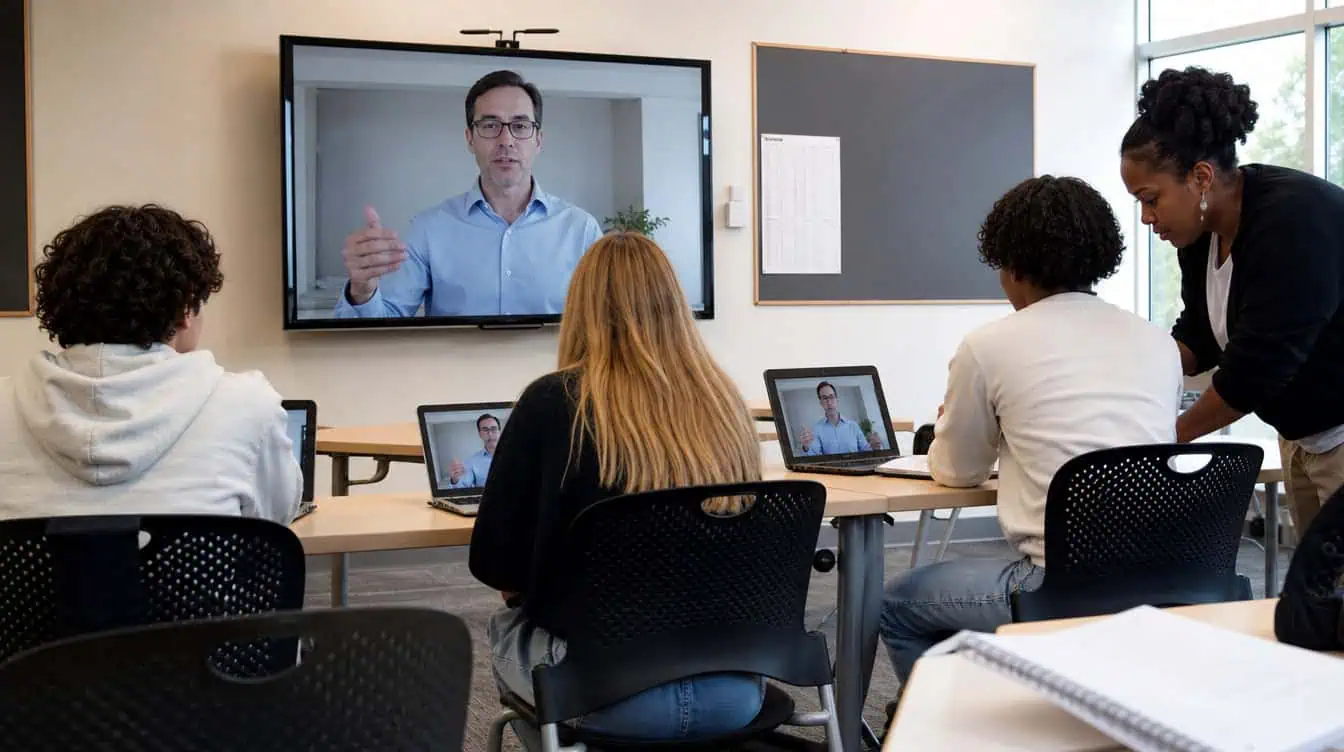
Instead of asking whether a program is virtual, ask what students actually experience during class. Are they taught live by a certified teacher? Can they interact with that teacher in real time? Is someone supporting them in the classroom? Are the teacher’s credentials verified? Does the model have evidence behind it?
Those questions tell you far more about instruction quality than a broad label ever could. Synchronous instruction is not an emergency workaround. Done well, it’s a structured way to put a qualified teacher in front of students when geography, staffing shortages, or course availability make traditional hiring difficult.
If your district is looking for ways to keep classrooms covered without lowering the bar for instruction, we’d love to show you how Proximity Learning’s live, certified model works.
Frequently Asked Questions
What does “synchronous instruction” actually mean?
Synchronous instruction means a teacher and students participate in a lesson at the same time. The teacher delivers instruction live, students interact in real time, and feedback happens during the lesson rather than later.
How can a district verify whether a program is truly synchronous?
Ask whether every class is taught live by a certified teacher and whether students can interact with that teacher in real time. Also ask for certification requirements, teacher-training details, bell-schedule expectations, and an explanation of in-classroom supervision.
What academic outcomes has synchronous instruction produced?
Proximity Learning’s results include a peer-reviewed study of more than 40,000 Memphis-Shelby County students and 2024–25 LinkIt data showing post-test gains in all eight measured subjects. Ask any provider for course-level results and how they were measured.
Isn’t “virtual learning” the same thing districts tried during the pandemic?
No. Emergency remote learning was a rapid response to school closures. Synchronous instruction is a purpose-built model centered on live teaching, certified teachers, real-time interaction, and classroom support. The technology looks familiar, but the instructional model is different.
How is a certified teacher different from a facilitator in this model?
The certified teacher is responsible for delivering instruction. The in-classroom facilitator provides physical, day-to-day support for students and classroom routines. The roles work together, but they’re not interchangeable.