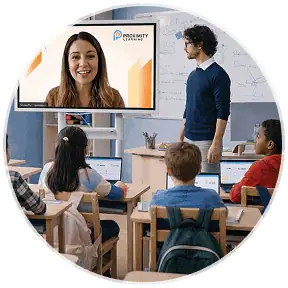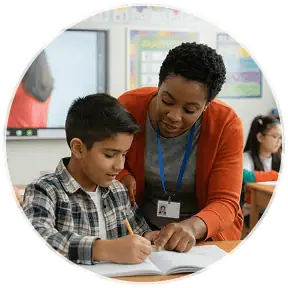


Across the country, school districts search for specialty teachers within their geographic area to no avail. When they cannot find a certified SPED, Spanish, or CTE teacher, districts cannot offer those classes. This means students have fewer opportunities to learn about varied subjects and alternate career options.
Expanding opportunities
One small town district couldn’t find a local robotics teacher, so the students were not exposed to this enrichment programming. By partnering with Proximity Learning, the district could add robotics classes, which students otherwise would not have access to. The community of ranchers and farmers “are used to hard work and building things with their hands,” so this class fits with the culture and work ethic of the area while exposing students to a new potential career option. Their virtual teacher Mr. A says, “I love that I had the opportunity to show them their mastery of rural farming is not unlike what they can learn about science and robotics.” With a little support and guidance from live expert teachers, students can start to hone and acknowledge their varied skill sets.
How does robotics help students?
According to Iberdrola, “Through play, educational robots help children develop one of the basic cognitive skills of mathematical thinking at an early age: computational thinking. That is, they help develop the mental process we use to solve problems of various kinds through an orderly sequence of actions.”
This logical process exposes students to a new way of thinking. It opens their minds to the analytical problem-solving required in science and engineering. The skills learned in robotics can easily be translated into many careers.
How do you teach robotics remotely?
Virtual certified teacher Mr. A says, “We go over the safety and ethical considerations of robotics first. Then, the fun stuff starts when we go into the technical aspects of robots. The students must learn the science behind robotics and its applications.”
He continues, “Later on, the students are taught the design and programming of a robot. If the school is willing, I help their students make their version come to life by coaching them in constructing a robot that they design and build themselves.”
Mr. A stands back and allows his creative students to lead the process. “It is very much their robot,” he explains.
Headed to state
“The students independently chose to enter their state competition after learning so much about robotics. They became very confident in their process and competed in December. Originally, building an actual robot was not the goal, but it very much became so,” Mr. A explains.
“There was a quote by a French aviator named Antoine de St. Exupery, ‘If you want to build a ship, don’t drum up the men to gather wood, divide the work, and give orders. Instead, teach them to yearn for the vast and endless sea.’ And that is true, and that is what happened.
“The school administrators and students really enjoyed and believed in the science of robotics. I never asked them to compete. It was 100% their decision to ask me to help them build a robot.”
Mr. A recently shared the good news, “The Proximity robotics class qualified for the Montana state championships with the robot we built in class. The students are super excited.”
Course expansion for all
“Robotics is attainable to anyone that has an interest in it,” Mr. A emphasizes. “It is not unique to the big city or Ivy covered classrooms, or even to a certain teacher. It doesn’t matter where in the world the student lives. All they need is a willingness to learn and a heart to desire what wonders machines and computers can do.”
Contact your state representative to expand your course offerings today.