
 Proximity Learning Team

Each August, rural district directors find themselves reposting the same teaching vacancy they celebrated filling just a few months earlier, as if caught in a never-ending loop. Whether it’s science, English, or special education, filling vacancies in rural districts means competing with the biggest districts for a teacher pool that hasn’t widened. A qualified candidate might see an incredible listing in a rural area, then decide to disregard it after pricing out the drive from the nearest metro area, the cost of a house 45 minutes from the nearest hospital, and the cost of relocation repeated across thousands of postings. This is not a simple staffing hiccup. It is a deep divide between what rural districts can realistically offer and what today’s teachers expect. Here, we explore why rural teacher shortages persist even when districts pull out all the stops, reveal the true cost of an unfilled classroom, and show how synchronous virtual instruction can bridge the gap without leaving any one district to shoulder the burden alone.
Key Takeaways
- Geography is the barrier: rural districts recruit from a smaller applicant pool.
- An unfilled position becomes a long-term substitute, a combined classroom, or a course a student never gets to take.
- Synchronous virtual instruction as a solution to the hiring equation
Why Recruiting Is Different
Rural recruiting is structurally different; a rural high school hiring a single physics teacher draws mainly from the same geographically anchored pool of candidates every year, and national research shows that teachers are far more likely to accept a job within about 15 miles of where they grew up, which shrinks the realistic applicant pool for any given rural district to whoever is from that area or willing to relocate there. This is a much smaller starting point than a suburban district a short drive from a major metro area ever has to work with. To add to the already-smaller pot, when you add human details such as a spouse or partner who also needs a job, or prices and the availability of nearby rental homes, the strong candidate applications deplete even further.
The Root Barriers Behind the Rural Teacher Shortage
Smaller Applicant Pools
Rural districts do not compete in the same job market as suburban ones. Since most teachers want to work near where they grew up, rural schools mostly rely on local graduates or a few people willing to move in. If those graduates leave for college and do not come back, the pool of candidates does not refill as it does in suburban areas. Data shows teachers are more than twice as likely to leave a rural school for an urban or suburban one than the other way around. This means every experienced teacher who leaves creates a gap that is hard to fill quickly.
Limited Housing and Spousal Job Markets
Studies of hard-to-staff rural districts show that housing assistance and special mortgage loans make a difference by addressing a real issue affecting rural teachers: the shortage of affordable homes near schools. If a candidate’s spouse or partner also needs a job in the same small area, even a strong applicant might decide not to apply before the superintendent ever sees their resume. Being far from a city makes things harder, too, since it affects the daily commute, access to specialists, shopping, and the chance for a second income.
Fewer Specialist Candidates for SPED, Math, and Science
Some subjects are hard to staff everywhere, but rural districts have the toughest time. Federal data from 2020 to 2021 shows that rural schools had much more trouble filling jobs in special education, physical sciences, and math than the national average. World language positions were the hardest to fill in rural schools, with more than half of those schools struggling to hire for that subject. Suburban and city districts also compete for these specialists, but they can usually offer better pay and a shorter commute.
What This Costs Rural Districts
Long-Term Substitute Coverage
When a certified subject teacher cannot be found, the fallback is rarely a permanent, if imperfect, replacement. It is a long-term substitute, brought in to hold the room together rather than to teach the standards in depth. A substitute can supervise the room and grade what is assigned, but without certification in that subject, the depth of instruction a student receives changes for as long as the vacancy lasts, which for some rural districts means an entire school year rather than a few weeks.5 Districts do not choose this option because it works well. They choose it because the alternative, an empty classroom with no adult of any kind, is worse for students and unworkable for a school day.
Combined or Split Classrooms
Another way districts address the shortage is by combining two grades in one room, by having two subjects taught by one teacher, or by assigning a teacher to a subject they are not certified in. Combined classrooms make it hard for even the best teachers to give each group enough attention, and teaching outside their areas of expertise affects lesson quality. These are not real staffing solutions. They are temporary fixes that districts use year after year because the main problem never really goes away, just gets passed on to someone already busy.
Falling Behind on State Testing Benchmarks
Studies show that high teacher turnover leads to lower student achievement, not just in empty classrooms but across the whole school. In an Education Policy Analysis study on teacher turnover and its effects on students and schools, researchers found that replacing a teacher costs around $20,000 when you add up recruiting, hiring, and onboarding. For rural districts already working with tight budgets and using substitutes or combined classes, that is money and time they cannot afford to lose again.
How Synchronous Virtual Instruction Solves the Problem
Certified Teachers Without Relying on a Local Applicant Pool
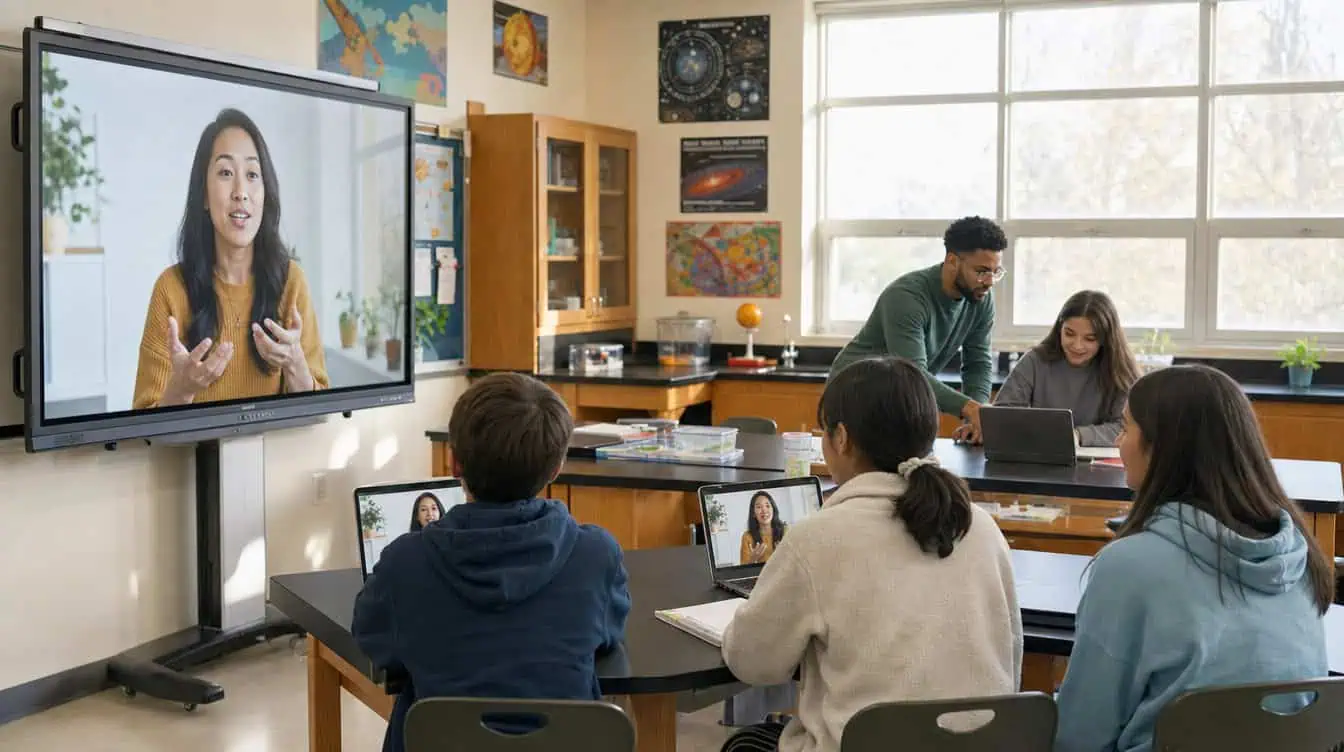
Synchronous virtual instruction removes the single biggest constraint on rural hiring: geography. Instead of recruiting only from the local pool of candidates willing to live in or near the district, a superintendent can draw on certified teachers anywhere in the country who are willing to teach into that classroom via livestream. The solution is not the pre-recorded, asynchronous video some districts relied on out of necessity in 2020, but a live, real-time class taught by a certified teacher who plans lessons, checks for understanding, and adjusts instruction in the moment, the same way an in-person teacher would.
In-Classroom Facilitator Support So Students Are Never Unsupervised
Livestreamed does not mean unsupervised. Proximity Learning virtual certified teachers are paired with a trained, in-person facilitator physically present in the room. Students always have an adult on-site to manage the classroom, support routines, and handle anything requiring a physical presence. The facilitator and the virtual teacher work as a team: one leads instruction, the other supports it on the ground. Districts get a certified subject-matter expert in front of students without losing the in-room presence that keeps a classroom running day to day
Fast Placement, Often Within Days
Since Proximity Learning is not limited to local candidates, it usually fills positions much faster than the traditional hiring process, which can take a whole semester or more. Public Schools partner with Proximity Learning because they need certified teachers quickly and without much fuss. Districts such as Manor ISD in Texas and Portsmouth Public Schools in Virginia have used Proximity Learning to fill their vacancies, and since then they have not had to leave a vacancy open all year while searching for a local teacher.
The Case for Synchronous Learning
Rural teacher shortages are not a failure of effort by superintendents or HR directors. They are the predictable result of a small, non-renewing applicant pool, a housing and spousal employment squeeze that salary alone cannot fix, and a national shortage of specialists in exactly the subjects that rural districts struggle most to staff. Synchronous virtual instruction does not ask a rural district to solve teacher recruitment on its own. By removing geography from the hiring equation and pairing every livestreamed, certified teacher with an in-classroom facilitator, Proximity Learning gives districts a way to fill a vacancy with a fully qualified educator in days rather than months, without leaving students without.
Frequently Asked Questions
Why is it harder to hire teachers in rural districts?
It’s a complex issue, including that rural districts face a limited, less mobile pool of applicants and are often located so far from teacher preparation programs that many potential candidates never even consider applying. Removing the geographical hurdles is one option that can narrow the gap.
How do rural districts recruit certified teachers faster?
With synchronous virtual instruction, districts can bring in certified teachers from anywhere in the country, livestreaming them directly into classrooms. This transforms a local search into a nationwide opportunity and helps fill vacancies much faster.
How much does a long-term vacancy cost a rural district?
Studies show that replacing a single teacher can cost a district $20,000 or more, not counting the extra expenses of long-term substitutes or combining classes while the search drags on.
Isn’t a virtual teacher the same as a video lecture?
No. A synchronous virtual teacher is livestreamed into the classroom. It’s a real teacher who plans lessons, checks for understanding, and adapts instruction on the spot, all while a trained facilitator is present in the room throughout the class.
Will a virtual teacher know our district’s curriculum?
Proximity Learning teachers are certified professionals who follow the district’s curriculum and pacing, just like any local teacher, ensuring that every student’s course aligns with the district’s intended curriculum.