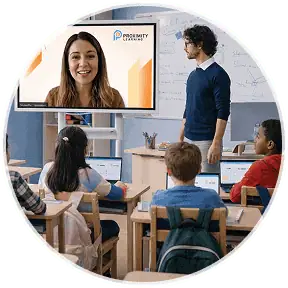

As K-12 schools across the United States have closed or moved online in wake of COVID-19, Proximity Learning teacher Lizette De Luna faced little setback when returning to classes after spring break. While other classes at her schools paused to allow teachers to adjust to teaching virtually, De Luna had been instructing online via live video since the start of the school semester and, in some of her classes, the school year.
“Because it has been some time now, I think now it has gotten a lot better, a lot easier as far as me teaching,” De Luna said. “We are still able to engage in a lot of discussions. We are still able to do assignments. The initial part of it was difficult, but I think it’s like that with everything. When something is new, you just have to have time to get acclimated to it.”
While De Luna is now spending her classes reviewing content with the students, she is still holding her quality of instruction to a high standard. She pulls from different online platforms during her lectures to engage her students with different learning techniques instead of relying solely on discussion.
“I don’t think you should change your mentality just because they’re home and not in a school setting, as far as (how) you deliver the instruction,” De Luna said. “Your delivery of instruction should still be high up there. It should still be quality education that you’re delivering.”
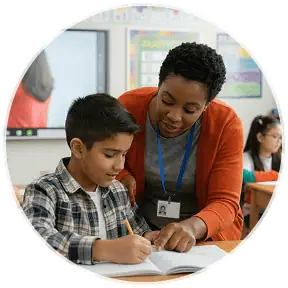
For students who do not have the technology at home to continue logging into De Luna’s class, she said the school provides them with paper packets to keep up with what is being taught and reviewed. While the in-class facilitators are no longer able to moderate the students in person, they help make copies of these packets for De Luna’s students.
During this time, her facilitators also work to communicate important school-related information to parents and continue to sit in on her live classes to track attendance and help keep students engaged. If participation is low during class, De Luna said the facilitator is very supportive in providing the students’ with positive reinforcement to help them engage in discussion.
Because she has been teaching her students online all school year, De Luna was able to build strong connections that caused some of her kids to feel impatient to return to her classroom after a two-week break.
“From the start, I always had that strong relationship with my students, and because it was so strong they were looking forward to starting instruction,” De Luna said. “I had a gap of maybe about a week where things were starting to get figured out as far as how we were going to roll it out and then as soon as we did I had a lot of students come in ready to learn, ready to be involved with the assignments, with me, with other students, with my facilitators.”
While De Luna has been teaching from home since the start of the school year, she is grateful that she is able to continue to connect with her students and be a familiar face while they learn from home for the first time. Students can log off after completing the day’s assignment, but she said some students have stayed on just to have someone to talk to.
“Whatever they need, they know that they can come to me for questions, for support,” De Luna said. “Not just content-wise, but also (because) it’s a hard time. It’s a difficult time for everybody.”
During this unexpected time, De Luna said one of her goals is to learn how to adjust for the future so students do not lose out on instructional time in not only her class, but in the brick and mortar classroom as well. With her experience with online instruction, she helped other teachers at her school learn the features of Zoom and gave advice on delivering instruction.
“I think any kind of involvement that the student does have is positive,” De Luna said. “They are coming into the class. They’re learning. They’re not just sitting at home. … They’re still getting that quality education that they would be missing out on if this wasn’t possible.”