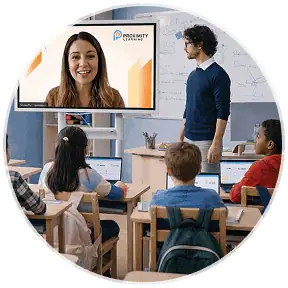


If you’ve stepped into a livestreamed lesson, you’ve probably noticed more than one adult helping students succeed. While the certified teacher leads instruction from the screen, the classroom facilitator role is equally important in creating an environment where students stay engaged, supported, and ready to learn. By managing the room, encouraging participation, and keeping the day running smoothly, facilitators remove friction that would interrupt learning.
The most effective facilitators don’t replace teachers or deliver content. That distinction matters. The teacher is state-certified in the subject and grade level and is responsible for instruction, assessment, and grading. The facilitator creates the conditions that let that instruction land. When everyone understands their responsibilities and works together, students get a stronger, more connected learning experience from the first bell to the last.
What an In-Classroom Facilitator Does
An in-classroom facilitator is the on-site adult who supports students during live, synchronous online learning while the certified teacher delivers instruction remotely. In this model, students and the teacher interact in real time through video conferencing, while the facilitator helps create a productive learning environment inside the physical classroom.
It is worth separating this from asynchronous programs, where students click through pre-recorded video lectures on their own. That setup does not require a second adult in the room. Synchronous instruction does because it is a live class with live participation on the school’s bell schedule.
Every school and district structures the classroom facilitator job description a little differently, but the core purpose stays the same: making sure students stay focused, connected, and ready to learn, so the teacher can concentrate on teaching. The responsibilities below show how effective facilitation supports both students and teachers every day.
Prepare the Classroom for Learning
Before instruction begins, the facilitator helps make sure the classroom is ready for a successful day of learning. This may include:
- Preparing classroom technology
- Confirming students can access the virtual platform
- Organizing resources
- Making sure materials needed for the day’s lessons are available
Facilitators set the tone by welcoming students as they arrive and walking through the schedule so students know what is coming and can settle in quickly.
Support Classroom Management
During live instruction, the facilitator watches how students engage with the lesson. They notice when attention drifts and redirect it, encourage participation, read the room’s mood, and draw out students who hesitate to speak in group discussions. They guide students back on task when needed and alert the teacher when someone needs support or clarification. This is information that a teacher on-screen cannot gather alone and is a key reason the two-adult model works.
Monitor Student Engagement and Participation
During live instruction, the facilitator monitors students’ engagement and participation in the lesson. They observe student attention to adjust focus as needed, encourage active participation, monitor the overall group dynamic, and encourage learners who may be hesitant to contribute to group discussions. When appropriate, they also help guide learners back to the task at hand and notify the teacher if a student needs additional support or clarification.
Facilitate Communication Between Students and the Teacher
Live instruction works best when communication flows in both directions. Facilitators relay student questions, share observations with the teacher, and help students who need something clarified during an activity or discussion. They also help students build their own communication skills by encouraging respectful participation and ensuring everyone has a chance to contribute.
Assist with Technology and Learning Resources
Technology is central to synchronous instruction, and facilitators help students navigate it throughout the day. They assist with:
- Logging into learning platforms
- Troubleshooting basic technical issues
- Locating digital resources
- Helping students access lesson plans, assignments, or classroom materials when needed
When a technical problem comes up, the facilitator resolves what they can and loops in the teacher or school IT staff if more help is needed. A five-minute login problem handled on site saves five minutes of instruction.
Support Individual and Small-Group Learning
Throughout the day, facilitators may work with individual students or small groups while the teacher leads instruction. They answer procedural questions, clarify directions, supervise small group or independent activities, and help students stay on task. Their role is to reinforce the teacher’s instructions and support learning, not to introduce new content or replace the certified teacher’s decisions.
Reinforce Classroom Procedures and Expectations
Facilitators create consistency by reinforcing routines and expectations set by the teacher and school. They remind students about procedures, participation, transitions, and appropriate behavior throughout the day. By helping students follow routines, facilitators keep the classroom organized and ready for learning from the opening bell to the last.
Why In-Classroom Facilitators Are So Important in Online Learning

While certified teachers focus on delivering instruction, in-classroom facilitators create conditions that let learning happen by:
- Keeping students focused and engaged
- Supporting effective classroom management
- Strengthening communication and classroom connections
- Providing timely student support
- Creating more personalized learning opportunities
- Helping teachers focus on instruction
- Promoting social and emotional well-being by building positive relationships that support social-emotional learning
- Improving collaboration between on-site and virtual staff
- Supporting diverse learning styles
- Creating a more consistent learning experience
Requirements to Become an In-Classroom Facilitator
Qualifications vary by district, but most facilitator positions do not require a teaching license because facilitators support instruction rather than deliver it. Districts typically look for candidates with:
- A high school diploma or equivalent
- Experience working with children or in an education setting
- Strong communication skills
- Effective time management
- The ability to work collaboratively with teachers, students, and other school staff
Because facilitators play a real part in supporting student learning, districts value candidates who are organized, dependable, adaptable, and comfortable with classroom technology.
Most districts provide onboarding and professional development to help facilitators understand classroom procedures, instructional technology, and how their responsibilities fit within a synchronous classroom. Candidates may also need to complete a background check, fingerprinting, or other employment requirements before working with students.
Requirements differ by location, but the goal is the same everywhere: preparing skilled facilitators who can confidently support students and teachers throughout the school day.
What Is an ESS-Backed Facilitator?
If a facilitator position is described as ESS-backed, it means the employee is hired, trained, credentialed, and supported by ESS, one of the country’s largest K-12 education staffing companies.
ESS serves over 900 districts nationwide by recruiting, hiring, training, and supporting substitute teachers, paraprofessionals, and other school support staff. Rather than being employed directly by the school district, facilitators work through ESS while serving in the district’s classrooms. ESS also provides onboarding, training, and ongoing support to help employees feel prepared for their roles.
Working through ESS is not a universal requirement to become an in-classroom facilitator. Some districts hire facilitators directly, while others partner with ESS or another staffing organization. For districts that use ESS, however, the arrangement can simplify recruiting, training, credentialing, and employee support, helping schools maintain qualified classroom support staff throughout the year.
Creating a Supportive Work Environment for In-Classroom Facilitators
Even the best facilitators can only do the job well when set up for it. They need clear expectations, the right resources, and a real partnership with the teacher on screen.
By intentionally building a positive work environment, districts help facilitators develop the confidence, skills, and knowledge to support instruction and contribute to a high-quality classroom. Here are five ways to do that:
- Provide facilitators with a clear job description that outlines responsibilities, expectations, physical demands, work environment characteristics, and opportunities for collaboration with teachers and other school staff.
- Offer meaningful professional development that strengthens instructional practices, communication skills, time management, and strategies for supporting different learning styles.
- Provide reliable technology, easy access to classroom resources, and dedicated time to communicate with the virtual teacher before and after class.
- Make reasonable accommodations when needed so facilitators can perform the essential functions of the role.
- Treat facilitators as a valued team member by recognizing their contributions, seeking their feedback, and fostering open communication with other teachers and the school.
Give Your Students the Support They Deserve With Proximity Learning
Students thrive when expert instruction is paired with consistent, on-site support that keeps learning moving. That pairing of a certified teacher with an in-classroom facilitator is what makes the model work for districts across the country and separates it from students working alone at home.
Proximity Learning has spent more than 16 years refining that model, starting well before the pandemic turned remote teaching into a national conversation. Today, we partner with 150+ school districts, have staffed more than 5,000 classrooms, and ensure every class is supported by an in-classroom facilitator alongside a certified teacher.
If you’re a district looking to strengthen your virtual learning program, Proximity Learning can help. Contact us today to learn more about partnering with our team.