


Ask any school superintendent about staffing issues over the summer and you will hear similar things: vacancies in many departments are still unfilled despite postings being up since spring. Teacher staffing isn’t just a hiring department problem. For superintendents and district leadership teams, it’s increasingly a school board planning question that affects budgets, course offerings, student access and instructional continuity. Many are turning to virtual teaching to build a staffing strategy that works.
The pressure is persistent. The National Center for Education Statistics (NCES) reported that 35% of public schools had at least one teacher vacancy in October 2024, while 50% of public school leaders said their schools felt understaffed. At the same time, districts have more options for addressing staffing gaps than they did a decade ago. That makes the question less about how to fill the immediate vacancy and more about how to build a staffing model that adjusts as needs change.
This is a strategic look at that shift: what district leaders are planning for, what data tells them and where synchronous virtual instruction fits into a longer-term staffing strategy.
Key Takeaways
- Staffing strategy is moving from reactive vacancy filling toward proactive workforce planning.
- District leaders use vacancy, enrollment, course demand, turnover, and hiring data to identify staffing pressure before it becomes an August emergency.
- Synchronous virtual instruction can be part of a planned staffing model, giving districts access to certified teachers beyond the local applicant pool.
- An adaptive strategy does not mean replacing traditional hiring. It means having multiple staffing options that can expand, contract, or change as district needs change.
Why Staffing Strategy Is Shifting From Reactive to Proactive
The numbers make a purely reactive hiring approach increasingly difficult to sustain. According to the NCES, In October 2024, 35% of U.S. public schools reported at least one teacher vacancy, and 3% of all public school teaching positions were vacant. Half of public school leaders said they felt their current staffing level was not sufficient.
The problem doesn’t start when a position appears on a job board. Teacher movement and retirement decisions affect the pool before a vacancy is posted. NCES found that 20% of public schools were operating with multiple teaching vacancies as of October 2024.
For district leaders, the implication is obvious: waiting until a vacancy becomes urgent limits the available options. A proactive staffing strategy starts by identifying where vacancies are likely to occur, which subjects are consistently difficult to staff and which resources provide coverage when local hiring doesn’t keep pace.
What Data-Driven Superintendents Are Prioritizing
Predictive Vacancy Planning That Starts Months Ahead
A staffing plan begins months before a position is posted. District leaders examine historical vacancies, turnover, retirements, enrollment projections, and course demand to identify positions that deserve attention early.
There’s no way to predict each departure, but districts can identify patterns. If a district repeatedly struggles to staff the same subject or grade level, that pattern should be part of the annual staffing plan rather than being a surprise each year.
NCES data provides a national benchmark, but districts have more useful information closer to home. Their own vacancy history, hiring timelines and course enrollment data show where staffing pressure is developing in real time.
Diversifying the Applicant Pool Beyond Geography
A district’s hiring pool is often limited by where qualified teachers live and whether they’re willing to relocate or commute. That’s significant for rural districts or specialized subjects with relatively small candidate pools.
A broader staffing strategy separates the question of where a teacher lives from where students receive instruction. Synchronous virtual instruction is one way districts access certified teachers beyond their immediate geographic area while keeping students in their existing classrooms. Proximity Learning, for example, connects districts with state-certified teachers through live, synchronous instruction, so hiring isn’t limited by where a teacher lives.
Building Flexibility Into Long-Term Staffing Contracts
A long-term staffing strategy doesn’t necessarily mean locking the district into one solution for every vacancy. District needs change with enrollment, funding, course demand, and hiring conditions.
That makes flexibility an important part of evaluating outside staffing partners. District leaders can ask whether a provider can support a single hard-to-fill course, several sections, or a larger staffing need, and whether the arrangement can change as those needs change.
The Memphis-Shelby County Schools experience illustrates one approach. In December 2024, the district’s board approved a six-month, $4.6 million contract for 100 certified teachers to provide live virtual instruction in hard-to-staff subjects and grades. The district had already used Proximity Learning since the 2018-19 school year.
Where Virtual Teaching Fits the Strategic Picture
A Planning Tool, Not Just an Emergency Fix
Synchronous virtual instruction is sometimes viewed as a method districts turn to after traditional hiring has failed. That’s one use, but it doesn’t have to be the only one.
District leaders can also plan for virtual instruction as part of their staffing mix. For example, a district might use live virtual instruction for subjects that have been difficult to recruit locally, year after year, while continuing to recruit and retain permanent in-person teachers.
Proximity Learning has provided synchronous instruction for more than 16 years, including before the pandemic, and provides live, certified teaching rather than prerecorded or asynchronous coursework.
Certified Teachers Without Geographic Constraints
The strategic advantage is not simply that a teacher can teach through a screen. It’s that districts can expand the pool of certified teachers available for a particular class.
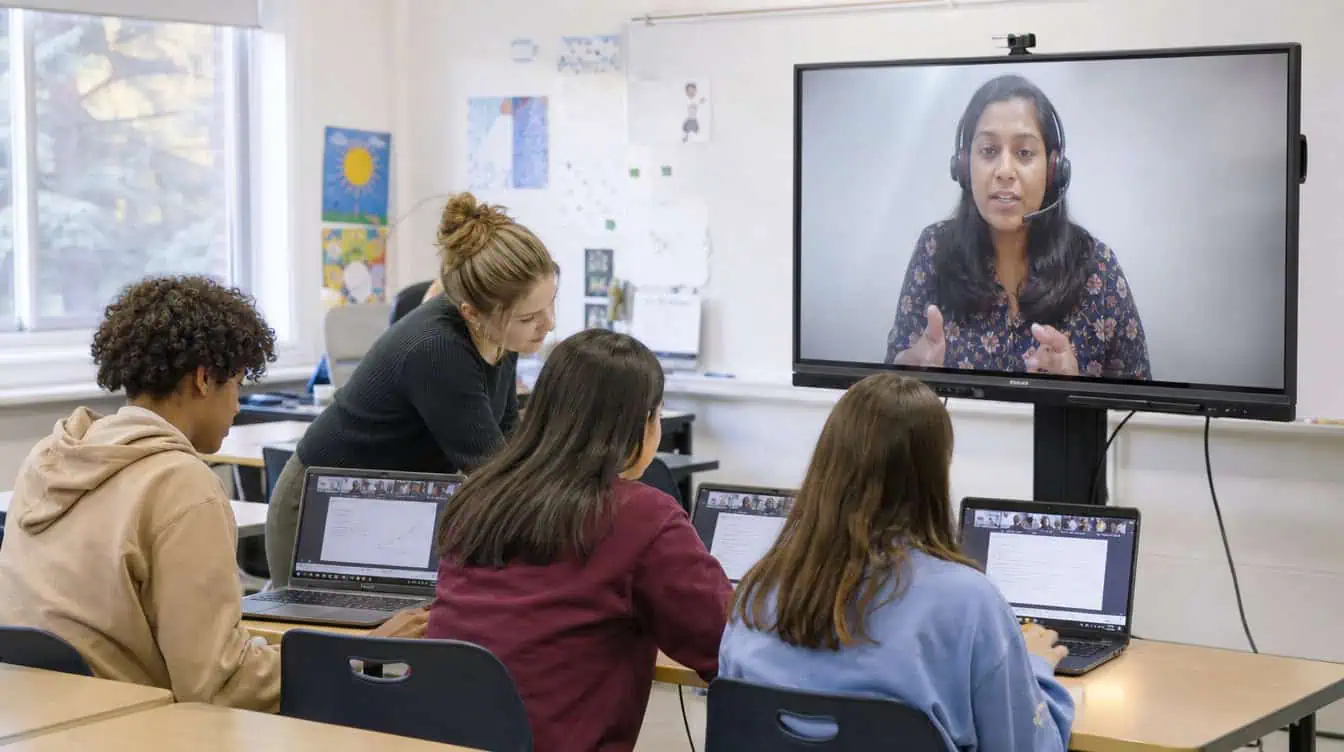
Proximity Learning matches districts with state-certified teachers according to grade level, subject and district needs. Teachers are livestreamed into physical classrooms, where an in-person facilitator supports the classroom environment.
That gives a district another option when a local search produces too few qualified candidates.
Proof Points District Leaders Can Bring to Their Board
Board conversations require more than a vendor’s promise. District leaders need specific evidence, clear measures and examples that can be discussed in terms of student outcomes and staffing needs.
One example is a Chicago State University peer-reviewed study of more than 40,000 students in Memphis-Shelby County Schools. The study examined 2021 and 2022 standardized test results and reported higher scores among students who had access to a Proximity Learning teacher across every grade and subject examined. Reported gains included 12 points in ninth-grade Algebra 1, a 9-point improvement in English from eighth to ninth grade and an 8-point average increase across grades and subjects.
Proximity Learning also reports post-test gains across eight subjects during the 2024-25 school year across 1,500 students, including gains of 23% in Chemistry, 22% in Algebra II and Biology, and 18% in Geometry and U.S. History. Named district partnerships provide another data point. Proximity Learning has worked with Chicago Public Schools since 2017, indicating a long-term relationship as a trust signal. Learn more about how Proximity Learning has helped districts.
What This Means Looking Ahead
Building a Multi-Year Staffing Strategy
The next staffing plan doesn’t have to be a prediction of exactly how many teachers a district will need five years from now. It should give district leaders a clearer picture of where staffing pressure is likely to emerge and what options are available when it does.
That means looking at staffing alongside enrollment, course demand, teacher turnover, retirements, and hard-to-fill subject areas. It also means deciding in advance which needs should be addressed through traditional recruitment and which may require additional approaches. A multi-year plan creates room for those decisions before a vacancy becomes urgent.
Evaluating Partners on Data, Not Promises
A staffing partner should be evaluated by what the district can measure. Questions for district leaders might include: How quickly can qualified teachers be placed? Which certifications and subjects are available? What student performance data will the district receive? How will attendance, engagement, and academic outcomes be tracked? Can the model expand or contract as district needs change?
Those questions turn a vendor conversation into a planning conversation. They also give district leadership information it can bring back to the board.
Preparing the Board for a Changing Staffing Model
Boards are usually accustomed to thinking about staffing primarily in terms of permanent employees, substitutes, and traditional recruitment. An adaptive staffing strategy broadens that conversation.
The objective is not to replace the district’s teaching workforce. It’s to give district leaders more ways to respond when the local labor market cannot provide the teachers students need. That distinction matters. Synchronous virtual instruction can be planned alongside traditional hiring, rather than introduced only after a vacancy has become a crisis. With clear expectations, performance measures and defined use cases, it becomes one part of a broader staffing model.
From Filling Vacancies to Building Capacity
Teacher staffing is a planning issue that extends well beyond the next open position. Persistent vacancies, teacher turnover, and changing course demands make it harder for districts to rely on last-minute hiring alone.
A proactive strategy gives district leaders more information and more options. It starts with understanding where staffing pressure is developing, then considers how traditional recruitment, retention efforts, and additional staffing resources can work together.
Synchronous virtual instruction can be one part of that strategy, particularly when geographic limitations make local recruitment difficult. The key is to evaluate any staffing model against the same questions: Does it meet the district’s instructional needs? Can results be measured? And can the approach adapt as those needs change?
If your district is planning beyond the next hiring cycle, Proximity Learning can help you talk through what that staffing outlook could look like.
Talk to Us
Frequently Asked Questions
Why is teacher staffing strategy shifting from reactive to proactive?
Districts continue to face vacancies and staffing shortages in specific subjects and grade levels. The NCES reported that 35% of public schools had at least one teacher vacancy in October 2024. Planning ahead gives districts more options before those vacancies become urgent.
How can a district build a more proactive staffing plan?
Start with the district’s own staffing history. Review vacancies, turnover, retirements, enrollment projections, course demand, and hiring timelines. Identify recurring problem areas, then determine which staffing options best address those needs before the school year begins.
What data should district leaders track to plan staffing ahead of time?
Useful measures include vacancy rates, time to fill, teacher turnover, retirements, applicant volume, certification areas, enrollment trends, and course demand. Districts can also track how often they need substitutes or other temporary coverage for recurring vacancies.
Isn’t reactive hiring just an unavoidable part of the school year cycle?
Some vacancies will always be unexpected. Proactive planning doesn’t necessarily eliminate every last-minute opening, but it does reduce the number of staffing decisions that have to be made under pressure by identifying recurring needs and preparing options in advance.
How does synchronous virtual instruction fit into a multi-year staffing strategy?
It gives districts another way to staff hard-to-fill subjects without relying entirely on the local teacher pool. Districts usually plan its use around specific subjects, grade levels, or staffing patterns and evaluate the model using defined student and staffing measures.