

What Is Facilitator Training?
Facilitator training builds the partnership between the in-person facilitator and the livestream certified teacher. Mandisa Vinson, Director of Strategic Accounts at Proximity Learning, leads this training for partner districts across the county, preparing facilitators and teachers to work as one team. She’s clear about how Proximity Learning wants to show up in a district.
“It’s our goal to make sure that we’re viewed as an instructional partner and not just a filler of personnel support.”
Before Proximity Learning instruction begins, Mandisa travels to the school to lead a hands-on workshop with facilitators and Proximity Learning teachers. The training has two jobs. It connects the facilitator and the teacher as a team, and it helps the facilitator get comfortable in a brand-new role. This matters because facilitators arrive from everywhere, from all types of backgrounds.
“Some are used to virtual, some have never touched virtual, some are not even in education.”
The end goal is student engagement. As Mandisa puts it, “The only way we can do that is by introducing what their role is and how it connects to our Proximity Learning teacher for success.”
Where the Facilitator Fits in Live Virtual Teaching
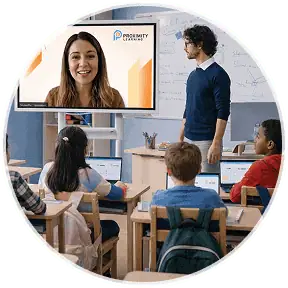
In Proximity Learning’s live instruction model, a certified subject teacher connects with students in real time. The facilitator is in the building every day, giving that teacher support on the ground. Together, they give students something a one-teacher room can’t.
“We want the students to have that double support, that double connection, that they may not get in a traditional classroom with one teacher.”
Mandisa describes it as two adults building on each other’s strengths. “You’re piggybacking off of each other. You’re making sure that both of you are feeling strong,” she says. The teacher leads instruction, while the facilitator keeps classroom management on track in person.
Because the pair can’t catch up in the hallway or in person, every conversation has to be intentional.
“They don’t have the ability to see each other in person, to sit next to each other in the teacher lounge. This allows them to say ‘Okay, intentionally, what do we want to talk about? How do we support the students? Let’s work together!’”
The payoff reaches everyone. “The student’s day is easier, the in-person facilitator’s day is easier, as well as our Proximity Learning teacher’s, if they’re all working together in a partnership.”
What A Facilitator Needs to Master
In Mandisa’s view, she does not see facilitators as fundamentally different from traditional aides. What changes is where the focus goes. Three skills rise to the top.
- Reading the room for the teacher. The livestream certified teacher sees the class through a camera. The facilitator sees everything else in person.
“Students, as we know, especially in high school, may be happy at nine o’clock, and then at 9:05 something happened and everything has changed. That in-person facilitator has to be able to see what’s happening in real time. Body language: Is Shelly having a bad day, and yesterday she was great. Let me tell our teacher so they can support together.”
- Creating a safe, organized space. Drawing on her years of experience in the classroom, instructional coach, and curriculum and instructional coordinator Mandisa says a positive classroom environment comes first.
“The students need to feel like the environment is a positive, safe space, so all they have to do is learn and worry less about everything else or distractions.”
- Overcommunicating. Every relationship needs communication, but this one depends on it. Why was a student moved? Who’s out of the camera’s view? What happened during the lesson?
“If you overcommunicate, nothing will be missed.”
Whether it’s a note in the chat, or a debrief during planning time, the result is the same. “Classroom management and very strong overcommunication are going to create a stronger partnership between our teacher and the facilitator. Therefore, the students are going to win.”
Inside the Training: What Admins and Facilitators Don’t Expect
Mandisa runs two trainings on-site: one for district administrators and one for facilitators. Each group walks away with something they didn’t see coming.
Administrators learn this is a real classroom. Having two adults in the classroom doesn’t mean it runs on autopilot.
“This is not a sit-and-get classroom that you bypass because there are two people in there. They still need the support. They still need you to come in and show up for them as well.” We appreciate the partners who make this a priority like all classes.”
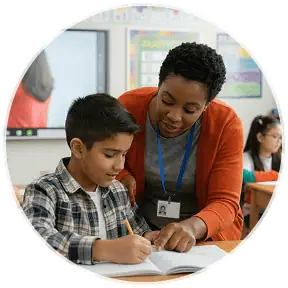
Facilitators learn they’re co-teachers. The range of people in the role is wide, and the training flexes to meet them.
“Someone may have been a bus driver yesterday and now they’re coming in as a paraprofessional, all the way to fellows who may be teaching the classes themselves next semester through a homegrown teaching program.”
To match that range, Mandisa covers several co-teaching models. Some facilitators focus on classroom management and keeping the technology running. Others move into team teaching, parallel teaching, or small-group work alongside the teacher.
Facilitators learn they can speak up. If students are lost, the facilitator can pause the lesson.
“We talk about how you are the individual who can stop it and support students’ needs as well. You can just say, ‘Excuse me, Ms. Davis, the students may need you to repeat that, as a team’”
The training even includes a personality assessment. Are you passive or outgoing? How do you like to communicate? “We try to go through the whole gamut so they feel comfortable once they meet their own Proximity Learning teacher.”
The Biggest Myths About Virtual Teaching
Myth 1: Virtual classrooms can’t be hands-on. This is the one Mandisa hears most, and the one she works hardest to debunk.
“The first thing you hear is, ‘Well, I don’t want students to sit and get.’ And we’re saying we don’t want them to sit and get either.”
Proximity Learning teachers are trained to move students from learning information to practicing it to applying it. On site visits, Mandisa sees it in action.
“We have science projects happening, students presenting, debates taking place, Socratic seminars taking place. So all of that is happening.”
Breakout rooms and small groups help teachers meet every learner, from students who need extra support to advanced students “who are ready to just fly away.” The key ingredient? “Is that the facilitator is open to being apart of the engagement.”
Myth 2: A virtual teacher doesn’t need planning time. Mandisa pushes back on this one, too.
“This is like a regular classroom. A teacher thrives with a planning period like brick and morton teachers do…it is helpful to the process.”
Planning time is where the facilitator asks the teacher, “What do you need from me? Do you need supplies? Can we do this activity?” It’s also why Proximity Learning asks districts to share their curriculum, pacing, and expectations up front.
Staffing It Right
Mandisa’s advice to districts starts with one word: intentional.
“If anybody has the ability to be impressionable to the students, it should be intentional if the school/district is able to, to hire an individual open to the opportunity to be apart of the team.”
This includes technology. If a facilitator is new to tech, give them support early. If the school doesn’t have one-to-one devices, flag it. Students won’t always be on laptops but the classroom best practice to have access is key.
Handling overcrowding is where live virtual teaching offers real flexibility here. One teacher can stream into multiple rooms or locations, reaching “more than 30 students.” But Mandisa still emphasizes the need for a facilitator in each room, so hands-on work can continue everywhere.
School culture plays a role, too. A virtual classroom takes on the culture of the school around it. Being apart of the district or school newsletters, helps build school community rapport.
“We want to be a part of it, and we want to be a positive reinforcement. Part of that is that you have to bring us in.”
What Poor Online Instruction Looks Like & How Synchronous Teaching Prevents It
Synchronous virtual learning keeps classrooms from falling into the trap of poor online instruction. According to Mandisa, poor instruction looks the same online as it could in person.
“We’ve had teachers who receive support internally to support student engagement just like in a traditional school environment.”. It’s the same thing virtually.”
Strong virtual teaching can be diverse and creative. It embraces inquiry-based questions, problem-solving, projects, and plenty of student talk. “Let them talk to each other about solving a problem and then present it. Let them be a part of the practice,” she says.
Cameras matter, too. Districts and schools need to align on students being visible.
“We’ve all been in meetings where everybody has their cameras off, and good conversation and interactivity just aren’t there when I’m looking at my own reflection.”
The real safeguard is a facilitator who knows they’re a part of the process, not a bystander. With two committed adults, the teacher is never teaching into a void.
“If there’s actually another person, they can be a two person island of excellence together.”
Keeping a Livestream Class Engaged
The most engaged classes Mandisa observes, virtually and on-site, all start the same way: connection.
“As a teacher, your first two weeks are about building connection. If they feel like you care, they’re going to care back.”
This connection belongs to both adults. Mandisa encourages the facilitator and teacher to present themselves as one team. “We did this together. How can we improve?” A united front keeps students from playing one adult against the other.
Facilitators also juggle more relationships than people realize. They work with administrators, students, and parents, who may reach out to them before the teacher. That’s why weekly meetings or ongoing check-ins are essential.
“We want to make sure they feel confident in what we’re providing for them, and that they’re part of a team where no one is higher or lower when it comes to student engagement.”
What Facilitators Say After Training
After nearly two and a half years of training, Mandisa hears one reaction more than any other.
“The majority, and it’s a large majority, is ‘Oh my goodness, I didn’t know it could be like this.’”
Facilitators are surprised to learn they have a voice, a role, and hopefully a planning time. Some have spent a month or two alone with a class before we enter into the plan with the district, doing their best in a subject that isn’t theirs. Others are surprised by something simpler.
“They’re surprised that a teacher comes in right on time with the students and the beginning of class to the end.. Synchronous means if the class starts at eight, they’re there at eight too.”
Not everyone walks in excited. Some just found out that morning they’d be part of Proximity Learning. Mandisa’s goal is realistic: help them feel more comfortable with at least one piece. Her favorite tip for tech-shy facilitators? “If you don’t know anything about technology, the students do. Find ambassadors in the classroom.”
The feedback she hears most is simple:
“Thank you, I feel better. I think I’ll be okay to move forward. Glad to know you’re here and that there’s reinforcement.”
Instructional Partners, Not HR Filler
Mandisa’s final point ties it all together. Proximity Learning is built like a school, with the support structure to match.
“We have department chairs. We have teacher learning specialists who are the instructional coaches for our teachers. We have facilitator support. We essentially operate like a brick-and-mortar school.”
This is the message she wants districts to remember: “We are a partnership, an instructional partnership.”
As a former athlete, she views it through a team lens.
“We don’t have to like each other, but the goal for us is student engagement. We’ll make it happen.”
Bring Live, Engaging Virtual Teaching To Your Classrooms
Great virtual teaching isn’t just a screen in an empty room, but a livestream certified teacher and a trained facilitator working as one team, every class period.
Ready to see what an instructional partnership looks like in your district?
Connect with Proximity Learning to learn how our teachers and facilitator training can support your students.