
Carlsbad Municipal School District partners with Proximity Learning to address special education teacher shortages, strengthen IEP implementation, and help students make measurable academic progress through livestream certified special education teachers and case management support.
When a school district cannot find enough certified special education teachers, the consequences extend far beyond unfilled positions. Students risk missing critical instructional time, teachers face mounting compliance responsibilities, and administrators must find ways to deliver the services every student deserves.
For Carlsbad Municipal School District in New Mexico, persistent special education staffing shortages made it increasingly difficult to meet student needs, implement Individualized Education Programs (IEPs), and maintain compliance. Despite extensive recruitment efforts, the district struggled to attract qualified educators to its remote community.
Through its partnership with Proximity Learning, Carlsbad found a way to bring certified special education teachers directly into classrooms through livestream instruction while also alleviating the case management burden on in-person staff.
The results have been encouraging: students are making academic progress, teachers are gaining valuable time to work directly with students, and school leaders have greater confidence in their ability to deliver required special education services.
As Heather Garner, Assistant Superintendent for Talent Acquisition and Development, explains, “The proof is coming in, and we are seeing growth in students where we had not seen growth before.”
The Opportunity: Addressing Special Education Teacher Shortages and IEP Compliance
A persistent shortage of certified special education teachers
Like many school districts nationwide, Carlsbad Municipal School District has faced a shortage of certified special education teachers. Its remote location creates additional barriers to recruitment, making it difficult to attract educators who might otherwise consider positions in larger metropolitan areas.
Chaundra Jarrett, Director of Human Resources, describes the challenge. “With Carlsbad being in a remote location, we do have a harder time attracting educators to this area. The cost of living is a little bit higher. There are not as many activities as in a big city, which is a little bit more enticing for those educators. So we tend to attract more hometown teachers.”
The pipeline of qualified special education educators presents another obstacle. Even as the district offers incentives, works to grow its own talent, and recruits from available university programs, the number of candidates remains insufficient.
Chaundra explains, “So recruiting special education teachers is very difficult. There are not many students going into special education programs. […] So it’s almost like a unicorn if you can find someone who is truly a special education teacher.”
Heather Garner emphasizes the limitations of relying exclusively on local recruitment. “Our access to teachers is very much smaller. Proximity has a national network of teachers that they have access to, and that’s something that I won’t ever have here in Carlsbad.”
Without enough qualified teachers, district leaders faced difficult decisions about how to allocate existing staff. Certified special education teachers sometimes had to focus on IEP paperwork and administrative responsibilities instead of providing direct instruction.
Heather explains, “Part of my role as an assistant superintendent is making those difficult decisions where I have to start looking at other positions. We may have a certified special education teacher serving as the role of an IEP specialist, and they’re just writing IEPs all day. Well at the end of the day, I need to send that person back into the classroom to really meet the student’s needs. But how can I alleviate that IEP burden?”
Protecting student services and maintaining compliance
For Assistant Superintendent for Special Programs Carrie Boatwright, the staffing shortage was not simply an operational challenge. It directly affected the district’s ability to deliver the services students were entitled to receive.
Individualized Education Programs outline the specialized instruction, accommodations, and related services students need to make progress. When qualified staff members are unavailable to implement those plans, schools face significant challenges in meeting student needs and fulfilling their legal obligations.
Carrie describes the problem plainly. “Compliance is almost impossible when we don’t have people to implement the IEP. We’re constantly looking at what’s called compensatory education. I think really and truly it just comes down to the student and how we’re shortchanging them if we can’t fill those vacancies and get certified teachers in there.”
The district also recognized that substitute coverage, while valuable, could not fully replace the expertise of a certified special education teacher. Chaundra explains why the district uses another approach. “We use Proximity Learning because they will use our curriculum, they meet the compensatory time, and there’s a certified teacher in the classroom teaching those kids rather than a long-term sub or someone who is not certified.”
The district needed a solution that could do more than fill a vacancy on paper. It needed qualified teachers who could deliver instruction, support IEP implementation, collaborate with campus teams, and help students make meaningful progress.
The Solution: Livestream Certified Special Education Teachers and Case Managers Within Proximity
Bringing certified teachers directly into classrooms
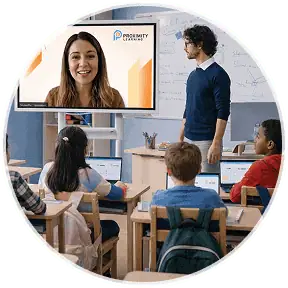
Proximity Learning helped Carlsbad address its staffing gaps by providing certified special education teachers who livestream into classrooms and deliver direct instruction.
These teachers develop lessons aligned with the district’s curriculum and each student’s IEP goals. Working alongside in-person instructional assistants, they support students in both general education inclusion settings and specialized resource classrooms.
The model allows students to receive instruction from a certified teacher even when the district cannot recruit one locally.
Prinicipal Amy Coll explains, “It’s valuable because without them our kids wouldn’t have anybody. I think it’s always ideal to have an in-person, but if you can’t find an in-person, we need our kids to have a certified teacher who can help them learn and grow and achieve. That’s what Proximity offers us, the chance to have a teacher in the classroom with the students.”
The approach accommodates different learning environments. Some students receive inclusion support in general education classrooms, while others work in small resource groups with targeted instruction and specialized materials.
Assistant Principal Rhonda Vaughan describes how the Proximity teacher pulls up the activity on one side of the screen and her picture on the other, so students can see both. “They’re working on their sounds. They’re working on their numbers there. So every math problem she’s working in, they can see her step by step so that they’re getting that direct instruction.”
This approach makes the virtual teacher an active participant in instruction rather than a passive presence on a screen.
Pairing instruction with special education case management
In addition to livestream teaching, Proximity Learning provides case management support that helps relieve the administrative burden on Carlsbad’s special education teachers.
Case management responsibilities can include coordinating documentation, monitoring IEP-related requirements, and helping ensure that student services are properly tracked. When these responsibilities consume too much time, teachers have fewer opportunities to work directly with students.
By supporting case management, Proximity Learning helps district educators devote more time to instruction while strengthening the connection between student services, documentation, and progress monitoring.
Chaundra explains, “We are using Proximity services for case management. This helps our special education teachers alleviate time away outside of their classroom. And they also have to meet intense instructional strategies to meet every student’s need. And by providing case management this helps alleviate the pressures.”
Carrie found that combining case management with direct instruction was especially beneficial. “I think when we paired case management with the service provision, it helped create a clearer picture of what those students were doing. We have somebody who’s working with the kid and collecting that information who can speak to parents and the rest of the team about what they see that kid working on and what the whole picture looks like for him.”
She continues, “When we have to disjoint it, it’s more difficult because then you have somebody trying to piece together paperwork who isn’t providing a direct service. So it did work better for us when we had the service provider and the case manager be the same person, and we teamed those two services together.”
This integrated model gives school teams a clearer understanding of students’ needs and progress while reducing the burden of coordinating instruction and documentation across multiple people.
Providing consistent, individualized instruction
A virtual teaching model is most effective when certified teachers know their students, understand their individual goals, and maintain strong relationships with the people supporting them in person.
Carlsbad’s experience demonstrates how these relationships can develop even when teachers and students are not physically in the same room.
Mika Wheeler, an in-person facilitator who works with Proximity Learning teacher Ms. Habasa, describes the connection. “The students love Miss Hibasa. They come in and they tell her, ‘Good morning, Ms. Hibasa.’ When they leave, they say, ‘Goodbye. Have a good day, Ms. Hibasa.’”
The relationship extends beyond greetings. Ms. Habasa remembers details about students’ lives, checks in with them, and uses that familiarity to build trust. “You have to build that relationship with these students for them to trust you to work with you.”
That trust supports individualized instruction, allowing the teacher to better understand student strengths, challenges, and learning needs.
Ms. Wheeler observes, “Our students in our resource classroom have grown tremendously this year. It was something new to them in the beginning, but they enjoy it. They love Ms. Hibasa. They communicate with her. She is very good about looking at their goals and seeing what they need to succeed in the year towards their goals. And she provides the material that they need to make improvements on that.”
Keys to Successful Implementation
Carlsbad’s experience shows that successful virtual special education is not simply a matter of putting a teacher on a screen. It depends on strong partnerships, prepared in-person support, consistent communication, and a shared commitment to student outcomes.
1. Establish a strong partnership between virtual teachers and instructional assistants
Instructional assistants or facilitators are essential to connecting livestream instruction with the classroom environment. They help students access materials, remain engaged, and participate in lessons while the certified teacher provides instruction remotely.
Principal Lisa Nesbit identifies this collaboration as one of the most important factors in the program’s success. “We want to make sure that she knows what we want for our students, how we expect her to provide that instruction, to develop the lesson plans that she’s teaching to them. And that brings the second most important factor is the instructional assistant. Because they are the boots on the ground, they are the hands behind the brains. And so, together they provide that instruction to the students. And without a good instructional assistant, it would not be successful.”
This partnership requires clearly defined responsibilities, mutual trust, and ongoing communication.
Ms. Wheeler describes how she and Ms. Habasa work together. “I think it works because Ms. Habasa and I have a really good relationship. We work well together. We have good communication. I think it also helps because I already have some experience working with the students and we kind of ping off of each other.”
The teacher brings certified instructional expertise and knowledge of special education, while the assistant contributes an established relationship with students and an understanding of the day-to-day classroom environment.
2. Invest in facilitator training and campus onboarding
Instructional assistants need more than technical access. They need training that prepares them to support livestream instruction and understand how to work effectively with the virtual teacher. Proximity Learning provides specialized training to classroom facilitators, helping them understand expectations and support student engagement.
Chaundra highlights the value of this support. “They also provide training to that staff. It alleviates some pressure from the district. Things move faster but they come and they train our staff, the facilitators that are in the classroom with the Proximity teacher. It is a specialized training.”
Carrie also emphasizes the importance of this hands-on preparation. “That in-person support is vital to getting students engaged, locked in, ready to learn and continuing to learn throughout the service piece.”
For Carlsbad, this training fills an important gap. District administrators may understand special education requirements without having the experience needed to train facilitators in a virtual instructional model.
As Carrie explains, “The training for them is phenomenal because I don’t have time to train the facilitator. I never taught online so I don’t have even experience to bring to the table. That’s something that Proximity brought with them, which we’re so appreciative of.”
3. Integrate virtual teachers into the school community
Virtual teachers are most effective when they are treated as members of the campus team rather than outside providers. In Carlsbad, Proximity Learning teachers participate in professional learning communities (PLCs), planning meetings, professional development, and IEP meetings. This integration helps them stay informed about curriculum expectations, campus priorities, and student needs.
Principal Coll explains, “The Proximity teacher is part of our campus in the form of our PLCs, so she works with our aide who is in the classroom physically. Our aide will open up a Google Meet, so that she can be part of the PLC. She does all the training and all the things with our campus. […] She’s part of us, and so she does all the things that our regular teacher does, just from afar.”
By participating in these activities, virtual teachers remain connected to the same conversations and professional learning that guide their in-person colleagues.
4. Maintain flexibility and responsive communication
Every campus has its own schedule, student needs, and operational demands. Successful implementation requires a provider that can adapt to those realities.
Principal Coll explains how flexibility supports the daily schedule. “One of the biggest things that works is flexibility because we’ve got assemblies going on, we’ve got different things going on. And so the teacher is like part of our campus really. She’s flexible and assigned just to our campus.[…] She rolls with that and she just picks them up the next time or she’s willing to adjust if we need her to adjust.”
Regular check-ins, campus walkthroughs, and problem-solving conversations also help ensure the program remains effective as needs evolve. Carrie explains, “The check-ins with the principals and the Proximity teachers is another key piece because it helps the collaboration, it helps them problem-solve in the moment.”
She adds that the partnership is strengthened by the willingness to address challenges together. “If we bring something up, okay, let’s work through that. Is this a Carlsbad problem, is this a Proximity problem or is it just a lack of communication issue?” This collaborative approach allows the district and Proximity to adjust practices when something is not working as intended.
5. Build a relationship grounded in student outcomes
Ultimately, successful implementation depends on a shared commitment to doing what is best for students. Heather describes the partnership as more than a contractual arrangement. “It’s important for people to know that this relationship that we’ve built with Proximity really is more than just my contract company. We have a true relationship and that works both ways.”
She values the willingness to revisit strategies and make changes when needed. “Sometimes Proximity just steps up and says, ‘Hey I don’t really think this is working and we’re not getting the result that we set out for, why don’t we make a shift and try this.’ So that piece is there too and there’s not a lot of companies that are willing to say I don’t really think this is working let’s try something else.”
For Carlsbad, the measure of success is not simply whether a position has been filled. It is whether students receive the instruction and support they need to grow. “At the end of the day, we’re always doing what’s best for kids.”
The Results: Improved Special Education Outcomes and Academic Growth
Carlsbad’s partnership with Proximity Learning has helped the district address vacancies while making progress toward its broader goals for special education students. District and campus leaders report academic growth, stronger monitoring of student progress, improved access to certified instruction, and greater confidence in the delivery of required services.
Students are demonstrating measurable academic progress
One of the most significant outcomes has been the academic growth observed among students receiving special education support. Heather describes a change from previous patterns. “The proof is coming in, and we are seeing growth in students where we had not seen growth before. Historically, we have also seen regression from year to year in this population of kids, and we are not seeing the regression at rates that we were once seeing.”
At the campus level, Principal Nesbit reports encouraging results from the district’s Measures of Academic Progress (MAP) assessments. “Looking at the data of the students who Ms. Habasa and our instructional assistant work with, they have shown steady progression all year long. One of our students even made growth above what was expected and normal, rising into the next RIT band on their MAP scores. So, we are seeing progress for our students.”
Principal Coll also observed improvement through the district’s NWEA assessments. “The students have really all grown since the beginning of the year to the end of year when we’re comparing on our NWEA. And really quite a few points on all of those students have been raised from those students across the board.”
These observations suggest that the combination of certified instruction, individualized lessons, and consistent in-person support is helping students make meaningful academic progress.
Teachers can monitor learning more closely
Livestream instruction also offers teachers a direct view of student work and engagement. Because students’ screens can be monitored during instruction, teachers can observe how students approach assignments, identify errors, and adjust their teaching in real time.
Principal Coll explains, “Sometimes our virtual teacher is able to monitor academics better than even our in-person teachers because she has all of their screens on her computer and she can see exactly what the students are writing. And that’s what she’s looking at to determine what’s going on. And so their academic monitoring is amazing.”
This visibility supports more responsive instruction and gives teachers additional information to use when evaluating student understanding and progress toward IEP goals. She adds that classroom curriculum data also shows ongoing improvement. “The students show that they are improving and growing each week.”
Students receive more consistent access to certified teachers
For Carlsbad, filling a special education vacancy means more than placing someone in a classroom. It means ensuring that students have access to the qualifications, instruction, and support their needs require.
Principal Nesbit explains, “Proximity Learning has helped fill the vacancy needs that we have on our campus, especially in the area of special education. And our students are showing progress.”
The district’s approach also helps reduce the need to rely exclusively on substitute coverage while administrators work to recruit permanent staff. Principal Coll explains the value of having a certified teacher available. “Of course, my first go-to is always going to be to advocate for in-person certified teachers. But we know the crisis that we’re in in finding those qualified, certified people to teach special education. So, having the certified teacher in Proximity has been helpful because she has been able to develop those lessons that help fill that gap.”
The partnership provides the district with another way to ensure students continue receiving instruction while recruitment efforts continue.
Case management helps reduce the burden of compensatory education
By combining certified instruction with case management support, Carlsbad can better coordinate student services and monitor whether required instruction is being delivered.
Principal Coll describes the operational benefit. “Proximity has simplified a little things because without them we would have been really looking for compensatory times for our special education students and that becomes a big deal. And so having that Proximity teacher on our campus has simplified that and made that not have to be necessary because we do have a teacher in there with those students getting that legal time.”
The district’s goal is to provide required services consistently, reducing the risk that staffing gaps create additional service-delivery challenges that must be addressed later.
Students develop relationships and feel part of the classroom
Academic performance is only one dimension of student success. For students receiving special education services, feeling comfortable, supported, and connected to their teachers can also be essential to learning.
Carlsbad’s educators report that students have embraced the virtual teaching model, including students who initially were unfamiliar with online instruction. Rhonda explains, “Academically, our students are growing. These are our special students, so they are not at grade level. But they are making steady progress, which is exactly what we’d like to see.”
She also describes how the teacher has become a familiar part of the school day. “Most of the time you cannot see in an inclusion setting. You can’t see which one she’s working with unless it’s directly one-on-one with a student.”
Ms. Wheeler’s experience reinforces that sense of connection. “I really enjoy the program. Our goal is always to have somebody in-person, but I think that this year it’s gone really well with us. I think having the teacher that we have this year has gone really, really well. She enjoys her job. She takes it very seriously, and it’s gone very, very good.”
For students, the result is a teacher who knows their goals, recognizes their needs, and remains actively involved in their learning, even from a distance.
A partnership the district plans to continue
After three years of using Proximity Learning services, Carlsbad plans to continue incorporating the program to address vacancies and ensure students receive required special education services from the beginning of the school year.
Chaundra explains, “For the past three years we have utilized Proximity Learning services. We plan to incorporate their services as we know that we will probably not fill all of our teaching positions, and we want to hit the ground running on the first day. We want to make sure our kids are successful and meet all of our compensatory services, their IEPs, everything that is required.”
Carrie offers a recommendation for other districts facing similar challenges. “I would say for any district, just don’t wait on the vacancies. Don’t wait for the people to show up. Move forward with the online support that you get through Proximity.”
Her advice reflects an important lesson from Carlsbad’s experience: planning ahead can help districts provide services when students need them rather than trying to make up for lost time later. “Districts, it’s worth it. It’s worth the time and energy you put in at the beginning because then you have a year of children getting services.”
Heather summarizes the impact of the partnership. “Proximity Learning helps us fill our special education vacancies, which we couldn’t have done without that partnership.”
Conclusion: Helping Special Education Students Thrive Despite Staffing Challenges
Carlsbad Municipal School District’s experience demonstrates how livestream certified special education teachers and case management support can help districts respond to persistent staffing shortages without losing sight of their most important responsibility: helping students learn and grow.
By connecting students with certified educators, aligning instruction with district curricula and IEP goals, training in-person instructional assistants, and integrating virtual teachers into campus teams, Proximity Learning has helped Carlsbad strengthen its approach to special education service delivery.
The district’s reported academic progress, including steady growth on NWEA assessments and a student advancing into a higher MAP RIT band than expected, offers encouraging evidence of what can happen when students receive consistent, individualized instruction.
Just as importantly, the partnership has helped relieve administrative pressures on district staff and given campus leaders another way to address vacancies while continuing to prioritize student needs.
For districts struggling to recruit certified special education teachers, Carlsbad’s experience offers a clear takeaway: virtual instruction can be a meaningful, collaborative solution when it combines certified teaching expertise, well-trained in-person support, strong communication, and a commitment to measurable student growth.
When local recruitment falls short, students’ learning shouldn’t have to wait. With the right partnership, districts can bring certified special education teachers into classrooms, strengthen IEP implementation, and help more students access the instruction and support they need to succeed. Contact us today.