

In the wake of the COVID-19 pandemic, schools across the United States have been searching for ways to keep students safe while also providing them with the learning experience they deserve.
In the middle of August, 12% of school districts said they planned to start their school year with hybrid instruction, according to a survey by the Center on Reinventing Public Education. Hybrid and blended learning options, a mixture of in-person and online classes, seem like a middle ground for reducing the risk to the virus while still allowing students to have a sense of normalcy by attending school.
Plus, the model allows for the most flexibility to meet the scheduling needs of districts. It gives schools the opportunity to implement a rotating schedule where they bring in smaller groups of students in the school at one time throughout the week, which can make it easier for administrators to enforce social distancing guidelines.
But, Harvard Epidemiologist Dr. William Hanage argued that the hybrid model is likely to be one of the worst options for virus prevention. Hanage said that many parents will need to seek child care on the days students are not at school during the workweek, which allows more opportunities for a child to become infected and bring it into school.
Rather than decreasing exposure to COVID-19, the hybrid model can have more possibilities for increasing it compared to fully online or in-person models.
Also, hybrid or blended learning may not be safer for teachers who are coming in contact with the same number of students, according to an article from Vox. Staff infection rates at schools using hybrid learning were actually higher than at schools with only in-person instruction, according to data from the COVID-19 Schools Response Dashboard on Sept. 22.
Additionally, many teachers at schools undergoing a hybrid model are having to be responsible for managing both in-person and at-home students. In some schools, teachers are having to do this during the same class, according to a story by nonprofit leader Brianna Donaldson. This doubles the workload for teachers and causes them to struggle to effectively cover content at a normal pace.
Because of this, the hybrid learning model has led some school administrators to expect teachers to cover only half of their normal curriculum, according to Education Week. Instead of helping students stay on track with their learning by meeting in-person, this method of learning is causing children to fall behind in their learning and face a greater risk of catching the virus.
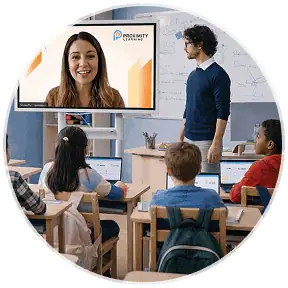
With our Enriched Live Instruction Model (ELIM), students didn’t miss a single beat when transitioning from in-person to at-home classes.
At Proximity Learning, we believe in connecting all learners with the expert teachers they deserve. Our new teachers undergo extensive training and guidance from mentors before logging into their first class so they feel prepared and confident to instruct effectively online. This way, students are receiving the highest quality education starting on day one.
When the pandemic closed the doors of schools across the country, our teachers understood the importance of being there for their students and providing them with as much normalcy as possible during a difficult time. Our classrooms go beyond just following the curriculum by being safe spaces for students to get away and connect with a teacher who values their well-being.
With real-time online instruction, students are also right on track in their learning with students in brick-and-mortar classrooms, according to a recent independent study done by Chicago State University. In our AP Chinese classes, students excelled on their AP tests this spring despite the pandemic.
Attempting to obtain the best of both worlds with online and in-person learning can widen the learning gap, overstress teachers, and put students and their families at risk for becoming ill with the virus. With ELIM, we can help school districts eliminate the education gap with our high-quality certified teachers, no matter where their students are learning.