
About Zion:
Zion Elementary District 6 serves over 2,000 K-8 students in Illinois. They strive to create a supportive, diverse community where every learner grows, achieves their potential, and thrives in a safe and inclusive environment.
The Opportunity: Unqualified Staff Strained the District
Zion Elementary District 6 had difficulty recruiting and retaining certified teachers due to its location. They tried to hire teachers through consultancy companies and another virtual solution, but both lacked the consistency Zion students needed.
Kerri Gilbert, Zion’s Instructional Programs Coordinator explains, “Prior to Proximity Learning, the staffing was a challenge for our district. We had a lot of teachers that had been with the district for a long period of time, but we had a low retention rate.
“We had a lot of teachers leaving mid-year or leaving at the end of the year, heading out to other districts. Another challenge we have is just the location of our school district, being at the northern end of Illinois, closest to the lake. We’re not close to the big urban centers, so it’s hard to retain staff.
“As a result, we had classrooms that were staffed by in-person consultants from consultancy companies that either were not qualified in their area and were working as long-term subs or they didn’t have the highest capacity to teach the subject areas that we would have liked.”
Jennifer Sajovec, Zion’s Teaching and Learning Coordinator, explains, “We called it the warm body in the room approach to staffing. As long as there was a person there supervising, that was okay. However, we had many times where there was a different sub every single class period. I started writing lesson plans for these classes. We were essentially just piecemealing lessons together, and students weren’t getting consistent science education at all. It was extremely stressful within the staff. […] It was a tremendous strain on the entire system.
“And so, our students were kind of getting a hodgepodge of content, and they were coming out of the middle school with very limited science knowledge, not much background knowledge as well. They weren’t meeting the standards, there wasn’t a continuity in the curriculum. It’s whoever was there, whenever, whatever resource happened to be in the room at the time.
“We also did not do much hands-on because it was very challenging to have either a different sub every period or we would have a contractor coming in who may not be very skilled at classroom management. And so, it became really difficult to manage supplies.”
The Solution: Hands-On Science Labs with a Virtual Teacher
Prioritizing quality instruction for their students, Zion partnered with Proximity Learning (PLI) to fill their science and dual language vacancies with live certified teachers. Erik Youngman, Zion’s Director of Teaching and Learning, says, “In the end, we want quality teachers, and if there is not a teacher available that we can hire who is certified or is not consistently present, then we must look at other options. One of those options happened to be a virtual teacher. We ultimately selected Proximity because we were looking for a certified teacher to work with our students on a consistent basis. We focus on effective teaching strategies with all of our teachers to impact our learners, and so when we have a teacher who is in person or a virtual teacher, the expectations are the same.”
Proximity’s teachers were reliable and engaging. “I have really seen tremendous growth within our district because of Proximity’s hands-on science project approach,“ says Jennifer. “They have regular science labs and make sure that kids are engaged more than just learning the content and taking notes.”
“Since [partnering with Proximity],” she continues, “I have seen the most hands-on experiments that I’ve ever seen in our science classrooms. Children expect that now. They expect collaboration. They expect to be doing creative poster boards or experiments within the classroom.”
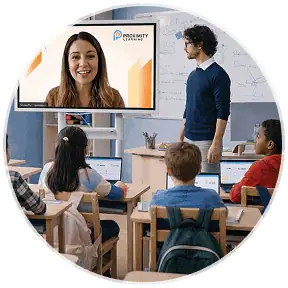
The collaboration between the Proximity teacher and the in-person facilitator provided extra value to Zion. “So, for instance, if you’re doing a science experiment in a traditional classroom, you’ve got the one teacher in-person who is managing the materials, passing things out, getting things ready, as well as trying to provide the instruction and support to the students. In our Proximity classrooms, that big task is divided up into two. So, we really were able to concentrate the instruction with our Proximity teacher and then have our para just be that support person to grab materials when needed to refocus student attention.”
Because of the consistency and quality of instruction, “We felt really safe in making a choice and knew that [Proximity] was advocating for us to provide the best education for our students,” Jennifer explains. “Since then, we’ve seen this program grow.”
Coordination Backed By a Whole Team
Mandisa Vinson, Proximity Learning Senior Manager says, “What a school district should know starting with us is that our goal is to fill a space that we know that they need, and that’s provide a certified virtual teacher. And that’s just the beginning.
“What we also want to be able to do is be ingrained in the curriculum instruction department as well, because that allows us to continue to have the growth in instruction. So, we want to come in and we want to ease their mind, the community’s mind, that there is somebody there in the classroom certified to help their teachers and to help the school district with what they’re looking for. Not only do we support that, we can continue to be a continuous year partnership. So, the growth continues on. The community feels invested. The district is invested.
“And, therefore, that allows us to continue to have a smooth partnership and to help with continuous growth and or provide a void that may be there, and that’s the feeling of a certified teacher that knows the students and can help with engagement.”
Every partnership is supported by a whole team that mirrors a district’s structure. “My role at Proximity Learning, as well as our overall support team, is extensive, and it parallels exactly what you may see in the district office,” Mandisa explains.
“We have a data team that’s responsible behind the scenes to make sure we’re aligning the type of teachers that have the credentials that Zion needs. Next, we have a Teaching and Learning Specialist who goes in and is the instructional support, looking at lesson plans, making sure they’re going in with virtual observations, and continuing to align with what the district wants and what Zion sees as best instructional practices. Then, we have our Customer Support Specialist who they see on a daily basis. That’s with check-ins, aligning with the facilitator, district administrator, as well as the PLI teacher to make sure we’re aligned.
“And then I have the great opportunity to be on site as the Senior Manager. I get a chance to walk in and see how are the students engaged, how is the facilitator and the PLI teacher working together, and observe on the land, to observe in real time how the students are engaged with our teacher. I get the opportunity also to meet with the district or with the principals afterwards and say, ‘What is the feedback? Where do we see some grows and where do we see some glows?’ So we can make sure we can take that back to our team, and we collectively provide the support that Zion needs and connects with their best practices for instruction.”
A Strong Teacher Needs a Strong Paraprofessional
Livestream instruction with Proximity Learning teachers works because in-person facilitators or paraprofessionals manage the classroom. “The relationship between the para and the instructor needs to be solid,” Jennifer says. “They need to have open communication. They need to be comfortable with one another so that the relationship continues to grow and thrive and students get what they need.
“The best relationships we have had are Proximity para and Proximity teachers who talk all of the time. Sometimes they form relationships outside of the school day as well because they’ve grown so close. So I would say for instructional coaches working with this, you really do need to be meeting with both the teacher and the para so that you can see what the needs are.
“You can talk openly and honestly about that relationship and what needs to happen. I would also say as far as instructional coaching for virtual instruction is concerned, just to keep pushing forward in making it as much of a model that mimics an in-classroom teacher as possible. So having interaction between the Proximity teacher and the students feel natural and authentic.
“One of the main benefits that I see of having our Proximity teachers really involved within our Zion 6 community is the ability to collaborate with other teachers in the building, especially if they’re working on a grade level team that sees the same students. For instance, our sixth grade team here at Zion does have a lot of collaboration about student support and about helping students who may be having a difficult time.
“And they regularly reach out to our Proximity teacher to get their input on how the student is doing as well as vice versa. Our Proximity teacher will join team meetings, and they will have a discussion about how to support this child or what strategies have worked for you. They will host parent-teacher conferences together. And so the parent gets a complete view of how that child is doing in school, including how that child is doing with a virtual teacher.”
“We really wanted a partnership that had strong connections between teacher and student, and a partnership where the paras and the teachers were working together to provide lessons that could help improve student achievement,” Kerri says. “And so as a result, when we shifted to PLI, the focus that I had was to make sure the rooms are set up in a way that are effective, so it didn’t feel like a virtual class. Through that experience in implementing good virtual teachers through PLI that helped show a successful implementation of virtual learning, we were able to see a more stable environment for our teachers.
“Our teachers weren’t subbing all the time. Our teachers were able to focus on their class and not have to deal with the stress of subbing a class during their prep hour. And we were able to have a person that was certified in the content area that we wanted them to teach to bring that level of expertise not only to the students, but to the team as a whole. Because it’s very valuable to have not only a certified staff for the students, but a full certified teaching team that can bring that expertise to team meetings, to team PLCs, to professional development opportunities.
“Prior to that, our science team was only one teacher. She can’t really do a PD by herself. So by adding the virtual component, we were able to bring more voices to the table. More learning could occur. And so not only did it strengthen the consistency in our buildings, but it also added that level of professional learning for our teaching community.”
The Results: Teachers Ingrained in School Community
“The day-to-day coordination between the Proximity Learning team and our district staff has changed over the years,” Kerri explains. “It essentially started in the first year with a lot of coordination and a lot of hands-on support with our teams. So our district would provide daily emails or weekly emails.
“We would interact pretty regularly on a weekly basis with our Proximity teams, providing direct instruction to the teams. Over the period of the last three years that we’ve been working with Proximity, we’ve worked to create our virtual teachers into the fiber of our schools. So we have made them teachers of record.
“They have been now connected to their staff directly, their principals directly. They’re on our principal email list. And so a lot of the coordination at the district level is now just making sure that they’re getting the communication from their principals.
“Our Proximity virtual team is also involved in all of our professional development. So a part of that coordination is making sure all of our PDs also have Zoom links and that they can connect virtually, as well as our institute days that we have activities for our virtual team that coordinate. We’ve been in the middle of a variety of curriculum shifts, as well, with a variety of our programs kind of changing curriculum.”
“Over the last three years that we’ve been working with Proximity, we’ve worked to weave our virtual teachers into the fiber of our schools.” -Kerri Gilbert
Jennifer expands, “We have seen teachers come back for their third year with us. And they have already started back in December saying, ‘I want to come back for my fourth year. How can I make that happen?’ And so it is extremely successful when you have people who want to come back year after year after year and know all of the people in our district, you know how to reach out and form those relationships with us. And it’s been really successful.”
“One thing that we do is we make sure that our Proximity teachers are included in building emails, just like any other staff member in the building. The principals are aware that they are responsible for adding them to those lists and emailing when it’s appropriate to come out, so our Proximity teachers online know when there is an assembly, what the theme is for the week, if there are spirit days coming up. They will often participate as well to feel part of that community.
“Another thing we also encourage is just for the principal to reach out directly to our Proximity teachers if there are questions, include them in conversations, as well as including them in meetings. So if there is a grade-level team meeting, please invite our Proximity teacher as well and have them up on the board. Many of our grade-level teams now just anticipate that and have started to do it naturally, and so they are regularly collaborating about the students they all see in person, and our Proximity teacher is just another person on that team.“
“If you are looking for options, Proximity has been dependable as a partner with Zion6,” Erik says. Leverage synchronous virtual learning for superior student engagement in every classroom.
About Proximity Learning:
Proximity Learning is a national leader in virtual K–12 instruction, providing live, certified teachers and special services to schools and districts facing staffing shortages. By leveraging technology to ensure equity in education, Proximity partners with districts across the U.S. to deliver high-quality instruction and innovative virtual learning solutions.