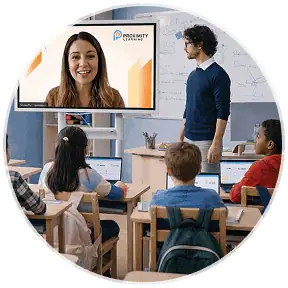


When districts talk about solving teacher shortages, the conversation often starts with filling vacancies. But for Milwaukee Public Schools, the goal was never just coverage. It was about protecting student opportunities.
For nearly 10 years, Milwaukee Public Schools has partnered with Proximity Learning to ensure students have consistent access to certified world language teachers, helping them stay on track for graduation while maintaining high-quality instruction across campuses.
What started as a solution for staffing challenges grew into a long-term partnership built on trust, communication, and shared commitment to student success. From middle school Spanish instruction to credit recovery and credit acceleration, Milwaukee has used live virtual teaching not as a temporary fix, but as a sustainable strategy for academic success.
Why World Language Access Matters
World language instruction is more than a graduation checkbox. It creates pathways for students to think globally, build communication skills, and prepare for future academic and career opportunities.
At Milwaukee Public Schools, students need two years of world language credits to graduate. That requirement makes consistent access to qualified teachers essential, especially at the middle school level, where early exposure helps students build confidence and continue successfully into high school.
Like many districts nationwide, Milwaukee faced the challenge of finding certified world language teachers who could support these long-term goals. Without reliable staffing, students risked falling behind on graduation requirements.
At Fairview School, a kindergarten through 8th grade school, Principal Eric Sullivan saw the importance clearly.
“We really wanted students to have opportunities to engage in a world language. In a global society, that is something that is incredibly important, and Proximity helped us make that possible.”
For Fairview, the goal was not simply adding another class to the schedule. It was ensuring students had meaningful early exposure to language learning early enough to make a lasting impact.
A Partnership That Has Lasted Nearly 10 Years
Many staffing solutions are reactive. Milwaukee’s partnership with Proximity Learning became something much bigger: a system built for consistency and growth.
Solmaris Gonzalez, Curriculum Specialist for World Languages and Language Immersion, has been part of championing virtual teachers throughout the district’s partnership with Proximity. Alongside Myken Caviness, Senior Vice President of Operations at Proximity Learning, she helped shape a model that evolved with district needs year after year.
For the full decade of Proximity Learning’s partnership with Milwaukee Public Schools, Sol and Myken have exemplified how trust, communication, and strong district collaboration create a successful and sustainable education pipeline.
As curriculum standards changed, textbook adoptions shifted, and district expectations evolved, the partnership evolved too.
“We’ve been partnering with Milwaukee for [nearly] 10 years,” said Myken. “Throughout this time, we’ve been able to align with what the district’s expectations are. We’ve aligned with textbook adoptions and adapted as standards changed. We evolve with the school.”
That flexibility matters. It means virtual teachers are not operating outside the district system. They are fully integrated into it.
Sol echoed that same experience from the district side.
“Year over year, while the district has made changes, Proximity Learning has been able to adapt to those changes and fulfill anything that needed to be done.”
She added one of the strongest summaries of the partnership:
“With Proximity Learning, Milwaukee Public Schools students always have access to certified teachers, when one is not available locally.”
That consistency has allowed Milwaukee to think beyond immediate vacancies and build a reliable instructional model that protects graduation pathways for students year after year.
Implementation That Works Because Communication Comes First
Long-term success with virtual teaching depends on more than simply assigning a teacher to a classroom. It requires operational alignment, clear expectations, and ongoing support. At Fairview, Proximity helped build a successful three-year implementation across sixth, seventh, and eighth grades.
Sixth grade students received foundational Spanish instruction and early exposure to language learning. Seventh and eighth grade students moved into coursework that supported graduation requirements and prepared them for high school success.
Before implementation began, both teams aligned carefully on what success would look like. Myken explained it simply:
“When PLI partners with a district, we make sure that we align on every front. We align on what the district expects for students, what they expect from campuses, and what they expect from teachers.”
That alignment continues through dedicated Client Success Specialists who support both district leaders and campus teams. Milwaukee uses district-level contacts alongside campus-based staff to keep communication fast, clear, and effective.
“For a district the size of Milwaukee Public Schools,” Myken said, “We really want to set up communication in a way that is easy for everybody and gets the quickest response possible.”
Sol specifically highlighted the strength of this support system.
“Our client success specialist is amazing. Whatever it is that we have needed, she’s made sure that we get it. The communication is very easy, not only with me, but with our principals and school-level leaders. I am very grateful for that.”
That operational consistency creates trust, and trust creates longevity. Principal Eric Sullivan pointed to that same reliability as one of the reasons the partnership continues.
“The communication on the Proximity side has been very strong, and you need that for a partnership to work. It definitely does with Proximity.”
He also emphasized the technical consistency that school leaders often worry about when launching virtual instruction.
“It’s been very reliable. Starting on time, ending on time, strong engagement, and we haven’t had issues with the technical side at all. That’s what keeps bringing us back.”
Students Feel the Difference
The strongest proof of success is always student engagement.
At Fairview, virtual teachers are not treated like outside providers. They are part of the school community.
“Our PLI teachers are fantastic,” said Sullivan. “They’re part of our community. They see our students three to four times a week, they know their names, they remember conversations, and students are drawn to that.”
That relationship-building matters, especially for middle school students.
Students begin to see language learning not as a requirement, but as something exciting and personal. They become more willing to participate, take risks, and continue their learning.
Sullivan described how students respond:
“They love going to it. They look forward to hearing a different voice in the room, learning those early stages of a language, and embracing something new.”
That excitement created unexpected momentum.
“When we started, we wanted some exposure initially,” Sullivan explained. “But we found it does way more than that. Our kids wanted more, so we added more days because the engagement was there.”
Students were not just participating. They were asking for more.
The impact became visible in course selection as well.
“We’re seeing students come back and choose Spanish One, Spanish Two,” Sullivan said. “We’re seeing it in real time.”
That continuation is one of the clearest indicators that the instruction is working.
Beyond Filling Vacancies: Creating Long-Term Opportunity
Milwaukee’s partnership with Proximity Learning now supports much more than middle school Spanish classes.
The district also uses virtual instruction for credit recovery, credit acceleration, and opportunities for students who speak languages not traditionally offered on campus. For students who need another chance to complete graduation requirements, access matters.
“With credit recovery and credit acceleration, we’re able to provide students opportunities they may not have had if it wasn’t for Proximity,” Sol explained.
That flexibility ensures students are not limited by scheduling constraints or staffing shortages. Instead, they have pathways forward. It also helps school leaders solve practical challenges around staffing, classroom space, and resource allocation. As Sullivan explained, virtual instruction helped fill a major middle school gap while remaining cost-effective and operationally realistic.
This is why the partnership has persisted, because it continues solving the right problems year after year.
Nearly 10 Years Later, the Results Speak for Themselves
By filling world language vacancies with certified virtual teachers, Milwaukee Public Schools preserved graduation pathways, maintained instructional quality, and ensured students continued earning required credits without disruption. Because Proximity teachers remained connected to campuses over multiple years, schools gained continuity. Returning teachers already understood the school culture, student expectations, and community needs, reducing onboarding challenges and strengthening long-term success.
For Milwaukee, virtual teaching became more than staffing support. It became part of the district’s educational strategy. And after nearly a decade, the reason for that success is simple: students benefit.
“We see a difference,” said Sullivan. “We see students having huge takeaways with the world language they’re studying. That’s why year three is happening, because it’s working.”
When districts invest in consistent, high-quality instruction, students stay on track, teachers feel supported, and schools gain the stability they need to keep moving forward.
That is exactly what Milwaukee Public Schools built.