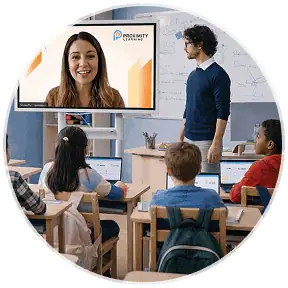


At Proximity Learning, we know what schools need because we’ve lived it. Many of our team members, from instructional designers to leadership, are former teachers and administrators. So when we talk about solving problems with edtech, we’re not talking about gimmicks. We’re talking about real solutions that actually help educators do their jobs better.
We’re exploring the future of virtual education from the inside out. Today’s topic: how school and district leaders are using virtual classroom software and AI tools to make learning smoother, more efficient, and more human.
Virtual School Isn’t New. But the Way We Run It Is.
The concept of virtual learning isn’t novel anymore. What’s new is how we’re optimizing it, not just for emergencies, but as a permanent part of district operations.
District leaders are rethinking how they deliver instruction, track outcomes, and support staff in a world where some classrooms are in-person, some are virtual, and some are hybrid. And to make it all work, they’re turning to a combination of virtual classroom software and AI-driven tools that streamline the chaos.
What Are Districts Using AI for Right Now?
Here’s what the most forward-thinking districts are doing:
They’re using AI tools not to replace teachers, but to free them up, automating the administrative tasks so educators can focus on teaching. Many of the best applications of AI in education are happening quietly behind the scenes.
From the EdWeek report, here are just a few current use cases:
- Translation for multilingual families: AI-driven translation tools are helping districts connect with non-English speaking families instantly.
- Auto-responders for tech support: One district used AI to handle over 20,000 support tickets in a year.
- Plagiarism and AI generation detection, to make sure students are doing their own work.
One district administrator in Idaho says, “I use AI daily—from helping to craft responses to emails, to creating PD, and as a thought partner to prompt me through decisionmaking.” The quick acceptance among teachers and administrators is likely to help them keep up with students, who are quick to accept and implement new technology.
As our team has said in previous blogs, “It’s wise to address issues head-on and come up with workable, effective solutions to common remote learning problems.” As AI becomes more commonplace, integration seems to be the frontrunner option. But how widespread should AI use be?
Supporting the Human Side of Teaching
We hear it all the time: ‘Teaching is personal.’
And we couldn’t agree more.
That’s why the most effective use of AI in virtual classrooms doesn’t replace the teacher, it will support them. When AI handles the repetitive, administrative, or data-heavy tasks, teachers get more time to build relationships and actually teach.
In our conversation with Kip Pygman, one of Proximity Learning’s leaders and a former public school administrator, he said it best:
“Teachers are the closest input to get the student learning output we want. If they’re not getting the support they need, it trickles down to outcomes.”
That’s why AI tools must be part of a larger ecosystem, one that still prioritizes live instruction, certified educators, and intentional, human-centered design.
What About Student Privacy?
Any time new technology enters the classroom, especially something as complex as AI, concerns about student privacy follow close behind. And for good reason.
When AI tools collect and analyze student data, from attendance patterns to academic performance, it raises real questions. Who sees that data? How is it stored? Could it be misused, leaked, or shared without families knowing? These are the kinds of issues that make parents and educators uneasy, and they deserve serious attention.
Privacy experts warn that risks can show up at every stage. That includes how data is collected and processed, how it is stored, and how it is shared. Even well-intentioned tools can cross a line by collecting more than needed, sharing too widely, or using student info in ways no one expected.
That’s one reason Proximity Learning has taken a different path. We do not use AI in our virtual classrooms. Our instruction is led by real, certified teachers who deliver live lessons.
We believe student safety and trust come first. While AI can be useful, it should only be used with purpose, clarity, and clear boundaries. Learning should feel safe for students, families, and teachers. That is non-negotiable.
So, What Comes Next?
AI is here to stay — but it doesn’t need to be overwhelming. In fact, when it’s built into the systems you already use, it becomes part of the flow, not just another add-on.
We see a future where school leaders spend less time chasing reports and more time supporting teachers. Virtual teachers could act quickly when a student disengages because the system flags it early. Where families get timely communication, and students get more consistent access to great educators.
That’s the power of combining live virtual instruction, smart software, and thoughtful AI.
Will AI Always Be Around?
At Proximity Learning, we’re not just watching these trends — we’re helping shape them. And we’re doing it with the same mindset we’ve always had: real teachers, real students, real results.
AI may be the tool. But intentionality is the engine.
We build systems that work with educators, not around them. For more information on finding teachers for your classroom, click here.